About Archidasyphyllum diacanthoides (Less.) P.L.Ferreira, Saavedra & Groppo
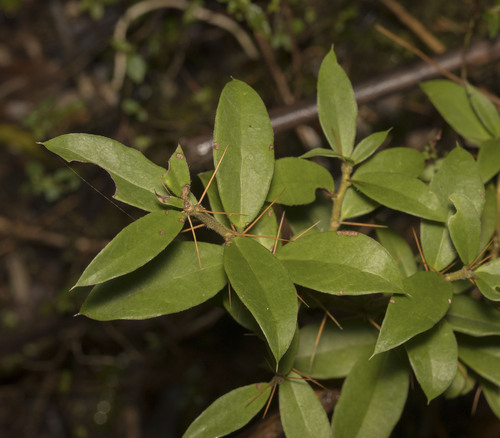
Archidasyphyllum diacanthoides is an evergreen tree or shrub that grows up to 15 m (50 ft) tall, with a trunk that can reach over 2 m (80 in) in diameter. The genus Archidasyphyllum, which this species belongs to, is unusual because it is one of the few genera in the Asteraceae family that contains tree species, rather than only herbs or shrubs. Its soft, thin brown bark is deeply fissured with longitudinal cracks. Its leaves are glossy, leathery, dark green on the upper surface and paler on the underside, borne alternately along stems. They are elliptical with smooth entire margins, and have acute tips that end in a single terminal spine. The leaves measure 2–6 cm long and 1–2.5 cm wide, are glabrous (hairless) on both surfaces, and have fine hairs along their margins; their leaf stalks (petioles) are 1–4 mm long. At the base of each leaf are two thorns, which are modified stipules and are deciduous. The plant's flowers are clustered into terminal inflorescences called flower heads, which are hard and scaly, similar to the flower heads of knapweeds, which are familiar European wildflowers also in the Asteraceae family. The flowers are white, hermaphrodite, and have 5 stamens with attached anthers. The fruit is a cylindrical achene around 3–3.5 mm long and 1 mm wide, covered in fine hairs, and has reddish pappi that are 5 mm long. Despite its inconspicuous flowers, which have little ornamental value, the plant is occasionally grown as a street tree in urban areas of Argentina, valued for its dense crown of evergreen foliage. In its native Chile, the bark of Archidasyphyllum diacanthoides is used as a folk remedy, applied both topically and taken orally, to treat blunt trauma. Locally it is called palo santo or palo blanco, and is also sometimes referred to by the synonym Flotowia diacanthoides. It grows naturally from Ñuble to Valdivia in Chile. Its bark is used to treat bruises and blows, either taken as an infusion or applied externally, and it is also used to dissolve warts. When not in flower, this species is easily confused with Latua pubiflora, a highly toxic species in the Solanaceae family. This similarity has caused many cases of anticholinergic tropane alkaloid poisoning from Latua in the Los Lagos Region of southern Chile, where both plants are native. One documented case involved a woodcutter who received a hard blow from the blunt end of his axe, went into the forest to collect bark of tayu (the local name for Archidasyphyllum diacanthoides) to treat it, and mistakenly collected latúe (the local name for Latua pubiflora) instead. He drank a concoction made from the wrong bark, became insane almost immediately, and wandered off into the mountains. He was found unconscious three days later, and required several days to recover, though he suffered severe headaches for several months after the poisoning.