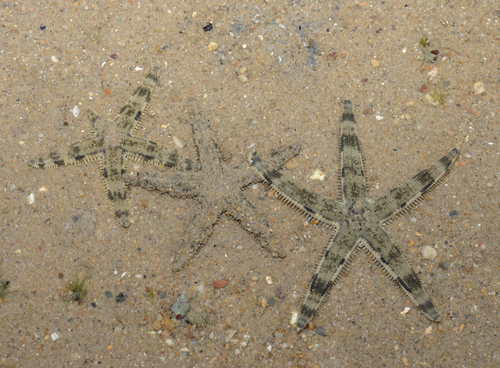
About Archaster typicus Müller & Troschel, 1840
Archaster typicus, commonly known as the common sea star, is most often a five-armed starfish with long, slightly tapering arms that end in pointed tips. Rarely, individuals can be found with three, four, or six arms instead. Adult individuals reach 12 to 15 centimetres (4.7 to 5.9 inches) in diameter, and males are typically smaller than females. This starfish is adapted to life on sandy seabeds: it buries into sediment during high tide, and moves across the sediment surface during low tide. Its upper body is generally grey or brownish, marked with a mix of darker and lighter patches that sometimes form a chevron pattern, while its underside is pale. Its body is slightly inflated, and a whitish madreporite sits near the center of its central disc. The small armour plates covering the upper surface of its arms are arranged in neat parallel rows, a feature that distinguishes it from the similar species Astropecten polyacanthus, which shares similar habits and colouring. The short, flat spines of Archaster typicus form a marginal fringe, and these spines are blunter than those of A. polyacanthus. Additionally, the tube feet of Archaster typicus have suckers, rather than the pointed tips found on A. polyacanthus tube feet. Archaster typicus is distributed across the western Indian Ocean and the Indo-Pacific, occurring at depths as low as 60 metres (200 feet). Its confirmed range includes the Maldive Islands, the Bay of Bengal, Singapore, northern Australia, New Caledonia, the Philippines, China, southern Japan, and Hawaii. It typically lives on seabed areas with soft sediments such as sand, silt, and seagrass meadows. Larvae of this species settle among mangroves, and individuals gradually move to seagrass and sandy habitats as they grow and age. Like other starfish, Archaster typicus is a broadcast spawner: males and females each release their gametes into the open sea, where fertilization occurs. However, unlike most other starfish, this species engages in pseudocopulation. Individuals reach sexual maturity when their arm radius measures 29 mm. Around two months before spawning season begins, the starfish start to gather in groups, and males in particular become more mobile. Individuals can distinguish between male and female conspecifics, most likely through chemotactic recognition. Once a male recognizes a female, he will climb on top of her and remain there for up to two months. The female can still move and feed during this period, but the male has much more restricted movement. This pairing synchronizes their gonadal development, so that when the female is ready to spawn, the male is also ready. When the female releases her eggs, the male releases his sperm almost immediately, which increases the chance of successful fertilization. In the Philippines, mating takes place in September and October. Pair densities can reach up to 7 pairs per square meter during the full moon, while no mating pairs are found during the new moon.

