About Arceuthobium pusillum M.Peck
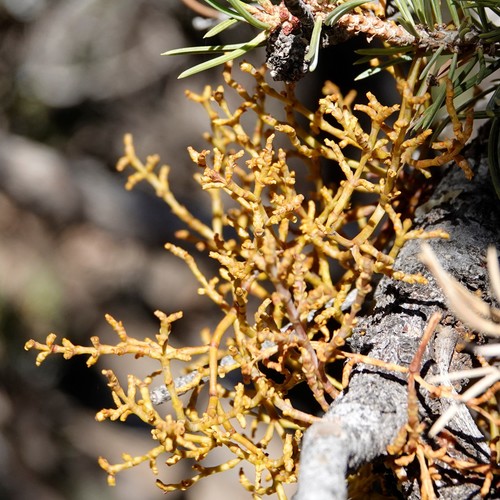
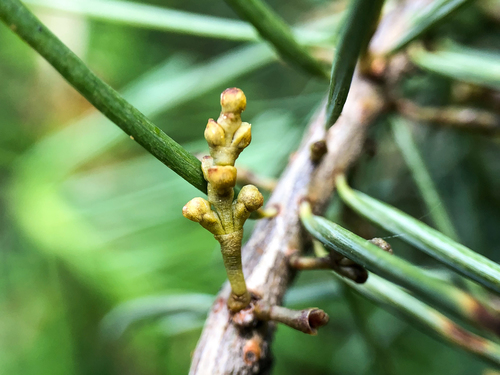
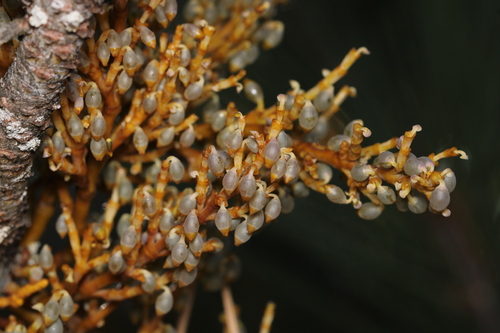
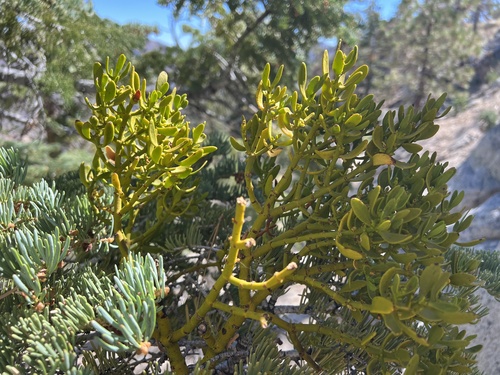
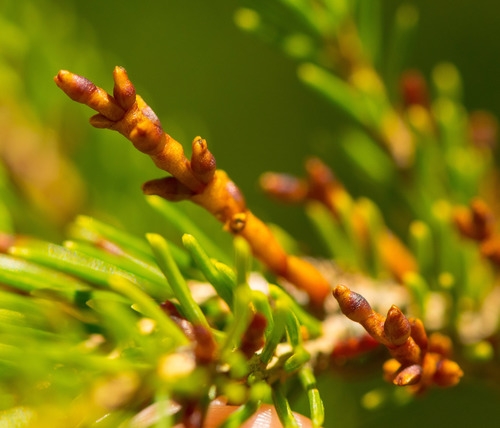
Arceuthobium pusillum M.Peck, commonly called eastern dwarf mistletoe, is a hemiparasitic plant that grows inside the stems of its host plant. When a seed lands on a host branch, it germinates and grows a haustorium that penetrates past the host’s cambium layer into the xylem and phloem tissues. The mistletoe draws the nutrients it needs for growth and reproduction from these host tissues. Before the mistletoe grows aerial stems, it is completely reliant on the host for all nutrients and energy; even after developing aerial stems, it still does not produce enough energy to sustain itself and remains dependent on the host. Between 2 to 12 years after infection begins, the mistletoe grows aerial stems outside the host stem it inhabits. These stems are typically inconspicuous, measuring only 0.5 to 3 centimeters (0.20 to 1.18 inches) long. Female stems are usually pale yellow-green, while male stems are red or red-brown. Eastern dwarf mistletoe is dioecious, meaning male and female reproductive structures grow on separate individual plants. Male (staminate) flowers are 2 millimeters across, and are mostly trimerous (having 3 petals or sepals), though they may also be 2- to 4-merous. Mature fruits are green berries measuring 1.5 to 3 millimeters. Seeds ripen in autumn, and the fruits forcefully eject seeds that are coated in a sticky substance. This sticky coating lets the seeds adhere to any surface they touch. After rain, seeds that have landed on needles slide down onto host stems, where they can then germinate and enter the host. Seeds may also be spread long distances by animals.