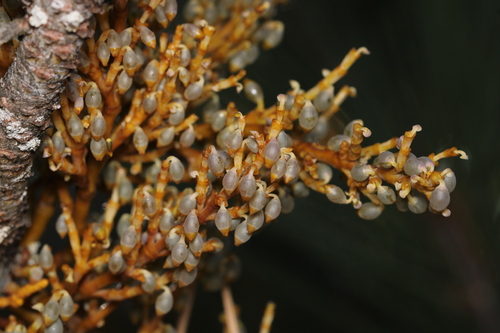
About Arceuthobium campylopodum subsp. cyanocarpum (A.Nelson ex Rydb.) Nickrent
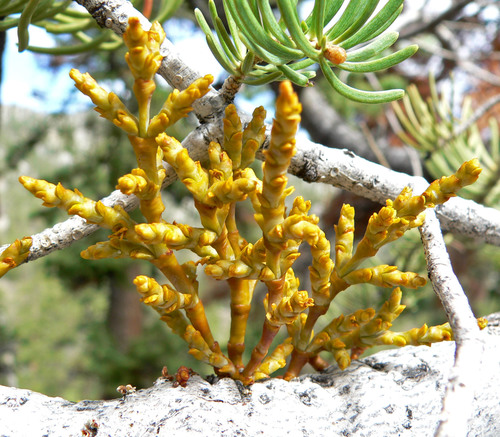
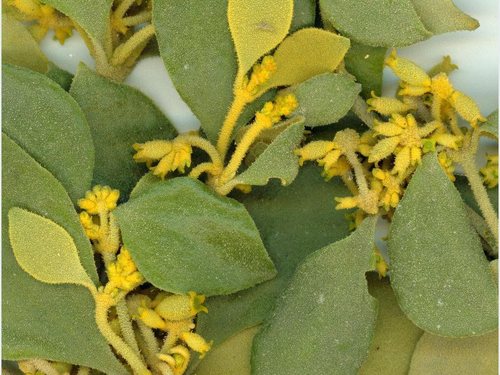
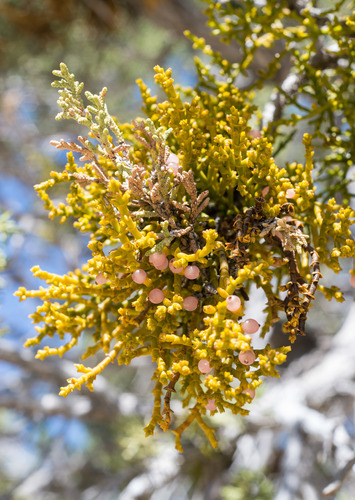
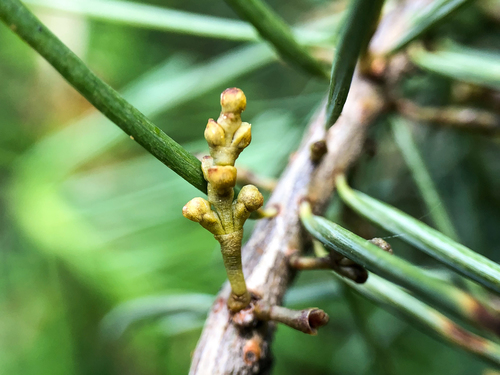
Morphology: For the first several years of its life, this mistletoe develops an internal tissue system called haustoria inside its host plant. Haustoria connect to the host’s xylem to withdraw water, and to the host’s phloem to withdraw nutrients. After this endophytic system matures, the mistletoe produces a network of aerial shoots that break through the host tree’s bark. These aerial stems can be green, brownish, or yellow, they branch in a flabellate pattern, and reach approximately 10 centimeters in length. The stems of Arceuthobium campylopodum subsp. cyanocarpum are often thicker and more robust than the stems of two sympatric, closely related species: A. siskiyouense and A. occidentale. The mistletoe’s leaves are very small, reduced to scale-like structures that clasp around its stems. Both stems and leaves contain chlorophyll, but the plant has a very low photosynthetic rate, so it continues to depend on its host for most of its carbohydrates. Distribution: This subspecies has a broad geographic range that largely overlaps with the range of its primary host, Pinus ponderosa. It occurs across much of the western United States, including Washington, Oregon, Idaho, California, and Nevada, as well as in Baja California. It grows at elevations between 30 and 2500 meters. Many sources that report a much larger overall range for A. campylopodum (such as the Flora of North America) use a broader taxonomic definition of the species that includes most or all species within Section Campylopoda. In Oregon and Washington, the subspecies’ range extends north to south along the eastern side of the Cascade Range, and also stretches from northeastern Washington and the Blue Mountains into most of western Idaho. Further south, it grows in the Klamath-Siskiyou region of southwestern Oregon and northwestern California. Its range continues south through California along the Northern Coast Range and the Sierra Nevada, reaching Nevada in the area surrounding Lake Tahoe. The southern part of its distribution includes several separate population groups: in the Transverse Ranges of southern California, along the Peninsular Ranges from southern California into Baja California (including the Sierra de Juárez and Sierra de San Pedro Mártir), and in the Spring Mountains of southern Nevada. Flowers and reproduction: This mistletoe is dioecious: each individual plant produces only male (staminate) or only female (pistillate) flowers. Male flowers have three or four petals, and measure 3.1 to 4.2 millimeters in diameter. Flowering (anthesis) occurs from mid-August to late September, with peak bloom between late August and mid-September. This timing is earlier than flowering of the closely related A. occidentale, and later than flowering of A. siskiyouense. The fruit is an oblong berry that averages 5 to 6 millimeters long and 3 millimeters wide. The fruit is typically light green, but may appear bluish gray or glaucous due to a waxy surface coating. All mistletoe plants growing on a single host tree can collectively produce between 800 and 2.2 million seeds each year. Peak seed dispersal takes place from mid-September to mid-October. Hydrostatic pressure building inside the mature fruit causes the seed to be explosively ejected at an initial velocity of approximately 27 m/s (89 ft/s), with an average dispersal distance of 10.7 m. The fruit contains a sticky substance called viscin, which makes up roughly one-third of the fruit’s total mass. Viscin helps the ejected seed adhere to the foliage or branches of any potential host tree it lands on. Uses: Some Plateau Indian tribes used this western dwarf mistletoe to make a wash to prevent dandruff.