About Arceuthobium americanum Nutt. ex A.Gray
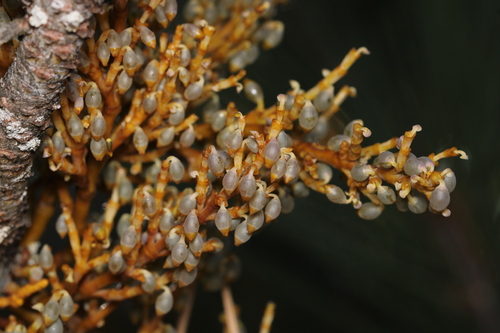
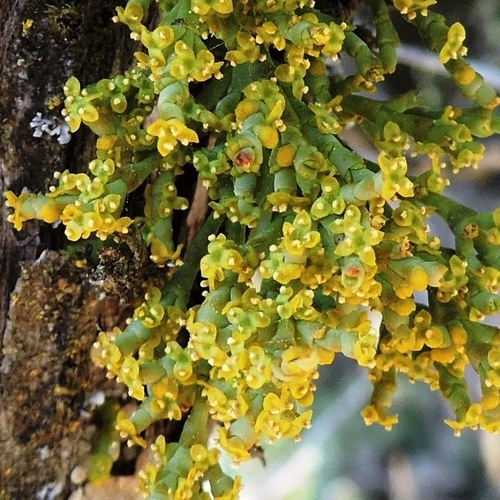
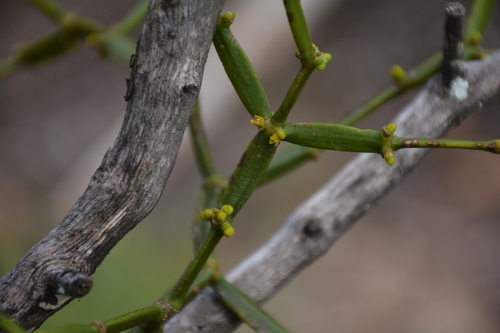
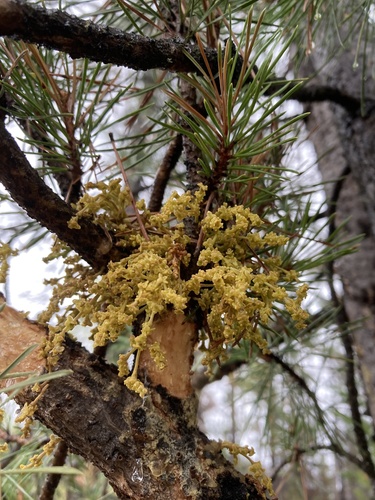
Arceuthobobium americanum Nutt. ex A.Gray, commonly called American dwarf mistletoe or lodgepole-pine dwarf mistletoe, is a species of dwarf mistletoe. It is a common plant native to western North America, where it grows in high elevation pine forests. It is a parasitic plant that infects Lodgepole Pine, particularly the subspecies Pinus contortus ssp. murrayana, also known as Tamarack Pine. This pine subspecies is most commonly found in the Cascade Range and Sierra Nevada. Most of the American dwarf mistletoe parasite grows beneath the host tree's bark, with only a yellow-green, coral-shaped structure visible above the bark surface. Its seeds mature in late summer and disperse to nearby host trees. This species disperses its seeds explosively through thermogenesis. It is a dioecious species, meaning it has separate male and female individual plants. Studies on infected pine trees show that infected pine needles have decreased starch content. Differences have also been found in the positioning of vascular bundles between pine trees infected by female versus male American dwarf mistletoe. Three hyperparasitic fungi are known to parasitize Arceuthobium douglasii: Caliciopsis arceuthobii infects the female flowers and fruit, Colletotrichum gloeosporioides causes black lesions at the stem nodes, and Cylindrocarpon gillii causes yellow-white lesions along the stems.