About Arceuthobium abietinum (Engelm.) Hawksw. & Wiens
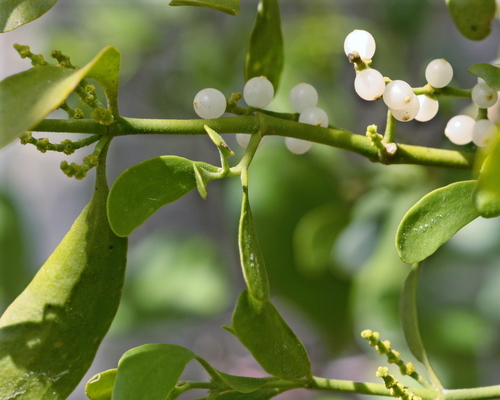
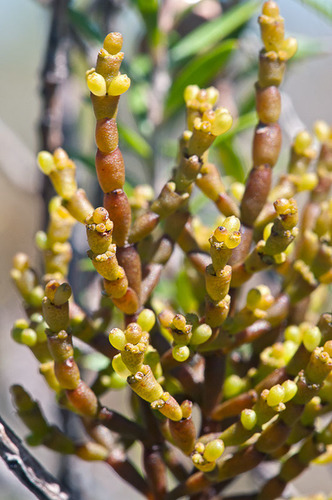
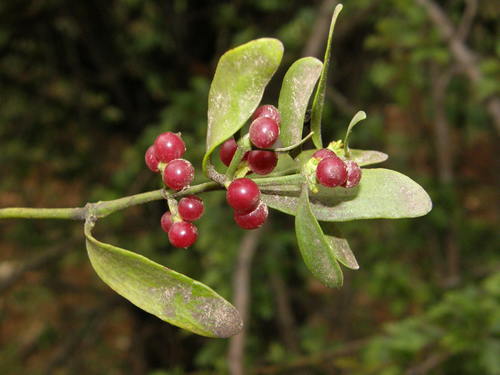
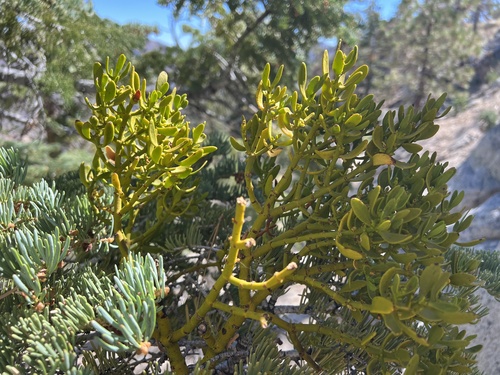
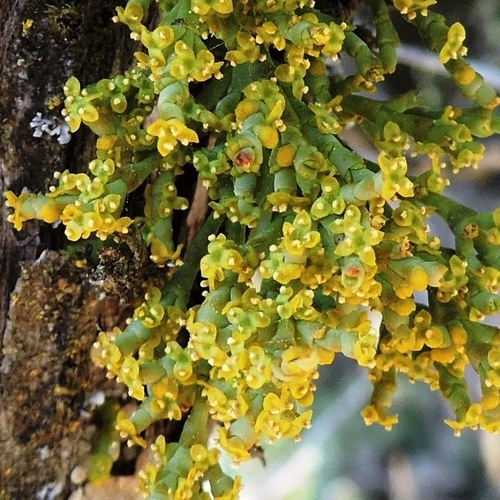
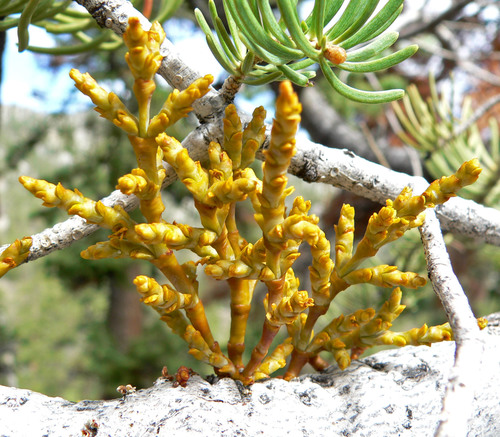
Arceuthobium abietinum (Engelm.) Hawksw. & Wiens is a parasitic dwarf mistletoe shrub that grows on conifer hosts. Like other dwarf mistletoes, for the first several years of its life it develops haustorial tissues inside its host’s branches. These haustoria tap into the host’s xylem to take water, and into the host’s phloem to extract nutrients. After 2 to 5 years of resource accumulation, the mistletoe produces a network of stems that emerge from the host tree to form a small shrub. The stems branch in a fan-shaped pattern; they average 12 cm in length, with a total range of 3.5 cm to 24.5 cm. The mistletoe’s aerial shoots contain chlorophyll and bear small scale-shaped leaves, but they have a very low photosynthetic rate. Because of this, the species continues to rely on its host for the vast majority of its carbohydrates. A. abietinum is dioecious: male plants produce spikes of staminate flowers, while female plants produce spikes of pistillate flowers. Male flowers have 3 or 4 petals, average 3 mm in diameter, and bloom from mid- to late summer, usually peaking in August. Female plants produce sticky, oblong, glaucous green berries that measure 4–5 mm long. Seed dispersal peaks in late summer to early autumn. Hydrostatic pressure building inside the fruit propels the seed at an initial velocity of 27 m/s (89 ft/s). Average dispersal distance for A. abietinum ranges from 9.2 meters to 10.7 meters, varying by variety. A sticky viscin coating on the seed helps it adhere to new host trees. Compared to most other dwarf mistletoes, A. abietinum has a wide distribution across much of western North America, found in Washington, Oregon, California, Nevada, Arizona, and Utah. The recognized varieties have distinct geographic ranges: Arceuthobium abietinum var. abietinum is limited to California, occurring from the southern Cascade Range through the Sierra Nevada, with an isolated disjunct population in the San Bernardino Mountains. Arceuthobium abietinum var. grandae ranges from southern Washington through the Cascade Range, and across the Siskiyou Mountains and Klamath Mountains of southern Oregon and northern California. Arceuthobium abietinum var. magnificae is limited to California, found throughout the Sierra Nevada. Arceuthobium abietinum var. mathiasenii has the southernmost distribution of all varieties, occurring in southern Nevada, southern Utah, Arizona, and northern Mexico. While its overall range is fairly broad, it exists only as a set of isolated populations. Arceuthobium abietinum var. wiensii is restricted to the Klamath-Siskiyou region of southwestern Oregon and northwestern California, an area identified as an epicenter of dwarf mistletoe biodiversity. Like A. abietinum var. mathiasenii, its populations are isolated rather than continuously distributed. Infection by A. abietinum harms the growth and overall health of host trees, reducing host longevity and seed production. The species commonly induces abnormal growth in its hosts, including the formation of witch’s brooms. These brooms are usually small, flattened, and nonsystematic, but A. abietinum var. wiensii often produces very large witch’s brooms on Picea breweriana. While these brooms give the mistletoe increased access to nutrients and provide valuable wildlife habitat, they also reduce the host tree’s vigor. Unlike many other mistletoe-conifer relationships, the witch’s brooms induced by A. abietinum do not significantly increase the host tree’s susceptibility to fire. On true firs infected by this dwarf mistletoe, secondary infection by the canker fungus Cytospora abietis is very common; this secondary infection causes flagging and death of affected branches. A. abietinum acts as a food source for squirrels and hairstreak butterflies in the genus Callophrys, including the thicket hairstreak and Johnson’s hairstreak. Clastoptera distincta, a spittlebug that specializes in feeding on dwarf mistletoes, has also been recorded feeding on A. abietinum in Arizona.