About Arborophila brunneopectus (Blyth, 1855)
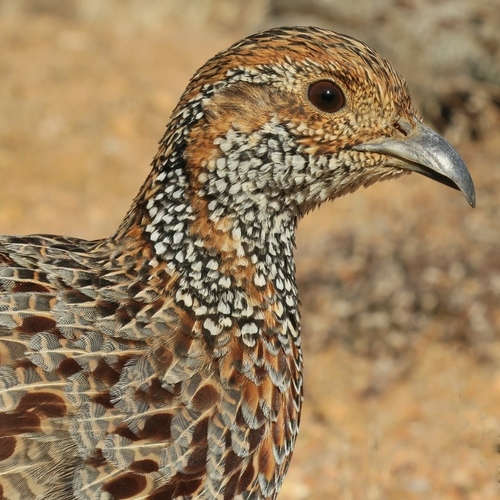
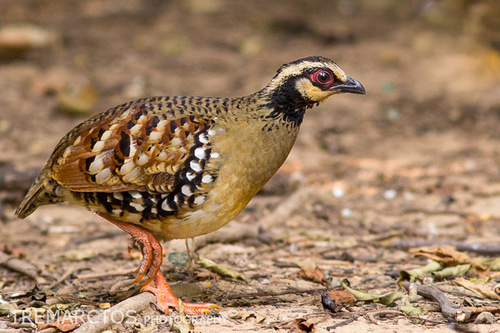
The bar-backed partridge, with the scientific name Arborophila brunneopectus (Blyth, 1855), has an average total length of 280 mm (11 in). Average wingspan measures 144 mm (5.7 in) for males and 134 mm (5.3 in) for females. Tails are typically 6–7 cm (2.4–2.8 in) long, and bills are around 20–21 mm (0.79–0.83 in) long. On average, male tarsi reach 42 mm (1.7 in), while female tarsi reach 39 mm (1.5 in). Male and female bar-backed partridges share similar coloration. Their overall base color is mostly buff. Black markings extend from the beak, around the eyes, to the throat; the species also has a black crown and black feather tips on the back. It has red eyelids, and its wing feathers are white with black tips, with additional brown coloration near the bird's back. The bar-backed partridge occurs in Cambodia, China, Laos, Myanmar, Thailand, and Vietnam, across an estimated range of 486,000 square kilometres (188,000 sq mi). Its natural habitats are subtropical or tropical moist lowland forests, and subtropical or tropical moist montane forests. It most often occurs at relatively low elevations below 910 m (3,000 ft), but has also been recorded at 1,500 m (5,000 ft) and higher.