About Araucaria heterophylla (Salisb.) Franco
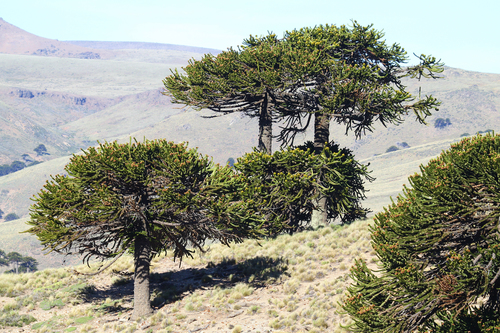
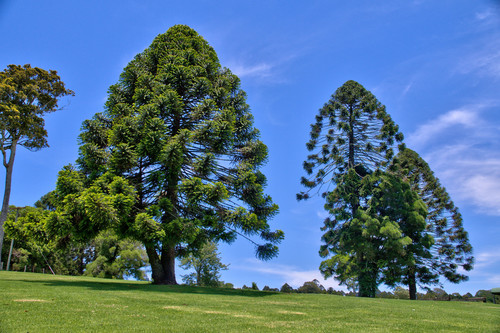
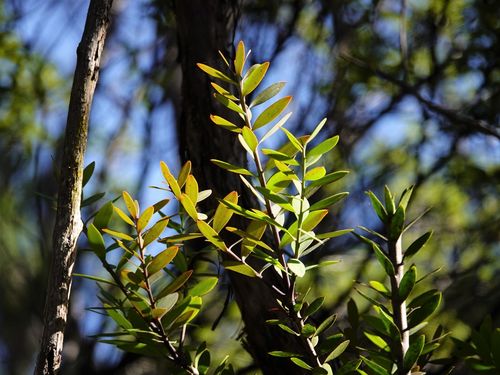
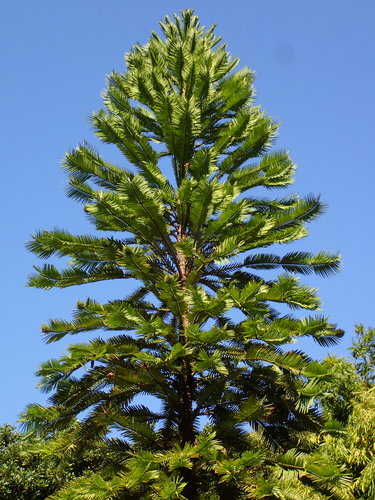
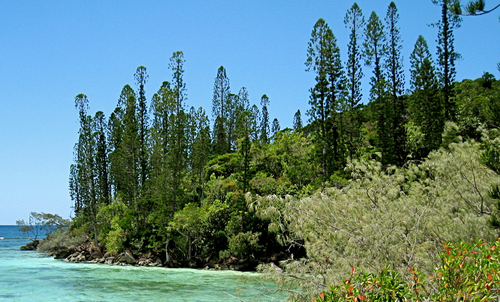
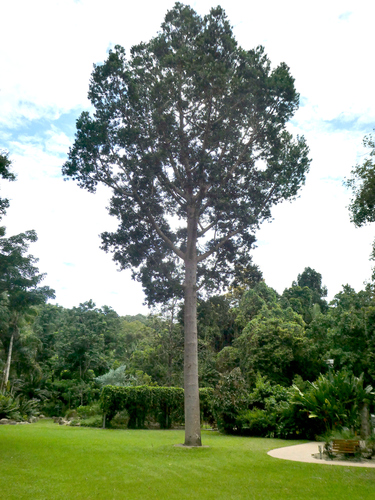
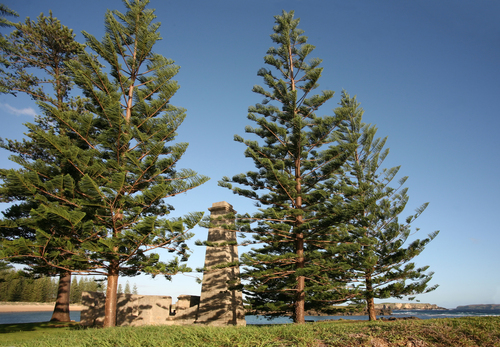
Araucaria heterophylla, commonly known as the Norfolk Island pine, is a slow-growing tree. Mature wild specimens reach 50–65 m (160–210 ft) in height, with straight vertical trunks and symmetrical branches that retain their shape even under constant onshore winds that contort most other tree species. Five almost horizontal or slightly angled branches grow from the straight trunk in distinct layered tiers, with each tier’s branch arrangement forming a perfect pentagon. Trees kept indoors remain much smaller than outdoor specimens. Its grey-brown bark sheds in fine small scales, and branchlets grow in regular whorls of four to seven. The species shows clear leaf variation between young and mature plants, which is referenced in its scientific epithet heterophylla, meaning 'different leaves'. Young trees bear soft, awl-shaped leaves that are 1–1.5 cm (0.4–0.6 in) long and around 1 mm (0.04 in) thick at the base. On older trees, leaves are incurved, 5–10 mm (0.2–0.4 in) long and 2–4 mm (0.1–0.2 in) wide. The thickest, scale-like leaves are found on coning branches in the upper crown. This species produces squat, globose cones that are 10–12 cm (4–5 in) long and 12–14 cm (5–6 in) in diameter. Cones take approximately 18 months to mature, then disintegrate to release nut-like edible seeds. The seeds are 2.5 to 3 cm (1.0 to 1.2 in) long, around 1.2 cm (0.5 in) in diameter, and have wide wings. Seedlings have four cotyledons. It is typically a dioecious tree, meaning male and female cones grow on separate individual plants, though some specimens can be monoecious. This tree has a distinctive appearance with widely spaced branches and a symmetrical, triangular outline, which has made it a very popular cultivated species, planted as a single specimen or along avenues. Mature trees may become less symmetrical over time. Despite its common name referencing Norfolk Island, where it is endemic, it is widely planted as an ornamental around the world due to its attractive exotic look and broad climatic adaptability. It grows in regions with suitable Mediterranean or humid subtropical climates. It grows well in deep sand, as long as young trees receive consistent water. Its tolerance for salt and wind makes it ideal for planting in coastal locations. When grown indoors, A. heterophylla needs a bright location with humidity of at least 40%, and humidity above 60% is preferred for healthy growth. Indoor trees should not be exposed to scorching sun or dry air from heating radiators, and the ideal temperature should not exceed 22 °C (72 °F). In winter, it should be kept in a bright room at around 17 °C (63 °F). Note that many trees sold as Norfolk Island pines in Hawaii, including their potted ornamental descendants grown on the U.S. mainland, are actually the closely related Cook pine native to New Caledonia; the two species were confused at the time of their introduction. In areas with winters too cold for outdoor growth (for example, most of North America and Europe), young A. heterophylla trees are often grown as houseplants, and are sometimes used as Christmas trees. The species cannot survive in areas with prolonged cold. A small number of outdoor specimens grow successfully in the subtropical Tresco Abbey Gardens on the Isles of Scilly, United Kingdom. The most northerly known outdoor specimen is a young tree growing on Valentia Island, on the southwest coast of Ireland. Potted saplings often develop a sparse, barren look; this issue can be improved by growing multiple saplings together in a clump. In northern climates, saplings can be placed outdoors during summer, or grown under grow lights, to encourage fuller growth. Outdoor specimens should be planted with plenty of space, as they can reach a very large mature size. The species is widely planted in coastal Southern California, where many specimens grow to well over 30 m (100 feet). It is often commonly confused with Araucaria columnaris. Araucaria heterophylla has been awarded the Royal Horticultural Society's Award of Garden Merit.