About Araucaria columnaris (J.R.Forst.) Hook.
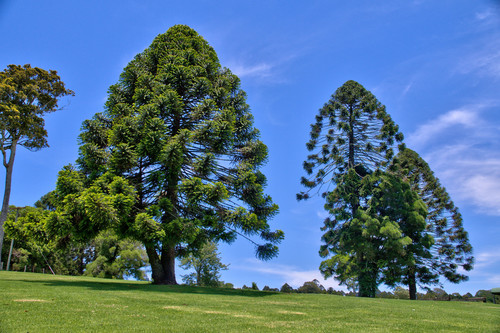
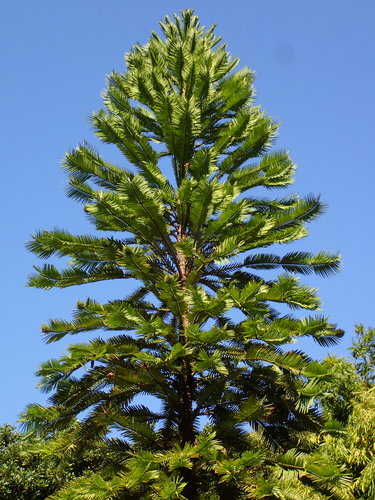
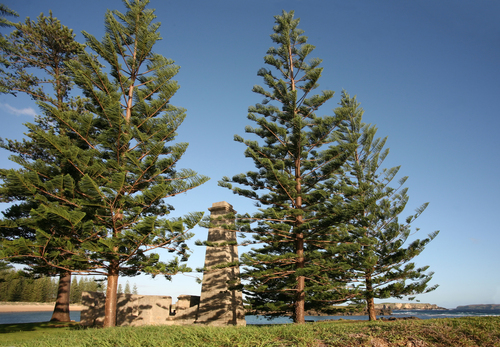
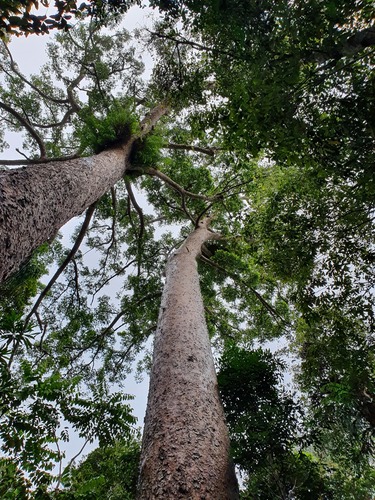
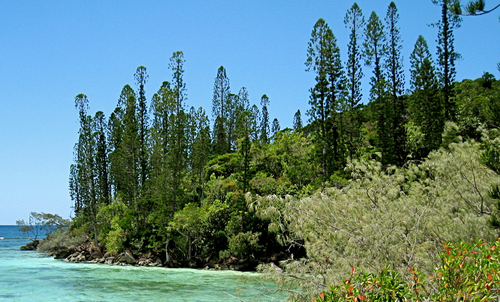
Araucaria columnaris is a distinct narrowly conical tree that reaches up to 60 meters (200 feet) tall in its native habitat. It has a slender, spire-like crown, and the shape of young individuals strongly resembles Araucaria heterophylla. Its bark is rough, grey, and resinous, and peels away in thin, paper-like sheets or strips. The mostly horizontal, relatively short branches grow in whorls around the slender, upright to slightly leaning trunk. Branches are lined with cord-like, horizontal branchlets. Branchlets are covered with small, green, incurved, point-tipped, spirally arranged, overlapping leaves. Young leaves are needle-like, while broader adult leaves are triangular and scale-like. Female seed cones are scaly and egg-shaped, measuring 10–15 cm (4–6 in) long and 7–11 cm (3–4 in) wide. Smaller, more numerous male pollen cones grow at the tips of branchlets; they are scaly, foxtail-shaped, and 5 cm (2 inches) long. A 2017 study found that this species tends to have a growth tilt that depends on which hemisphere it grows in: trees grow upright at the Equator, lean south in the northern hemisphere, and lean north in the southern hemisphere. This tree is endemic to New Caledonia, located in the Melanesia region of the Pacific. It was first classified by Johann Reinhold Forster, a botanist who joined Captain James Cook's second voyage to circumnavigate the globe as far south as possible. Its name honors James Cook directly, not the Cook Islands.