About Araucaria bidwillii Hook.
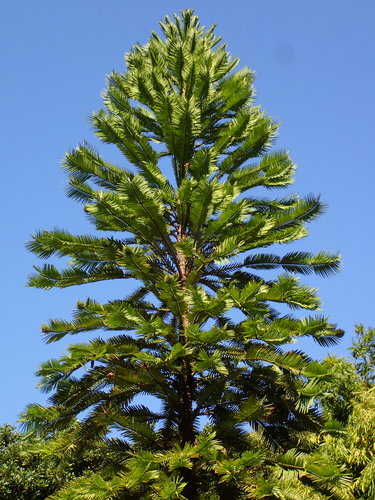
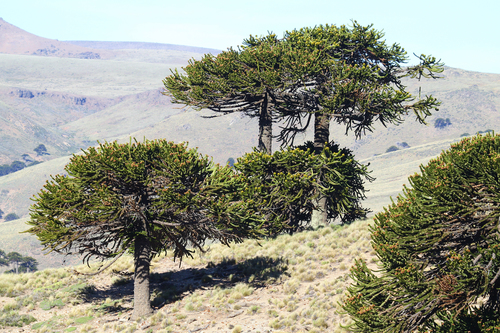
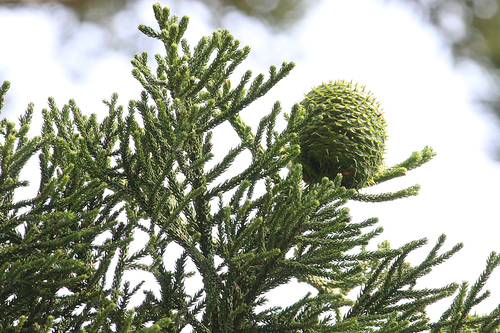
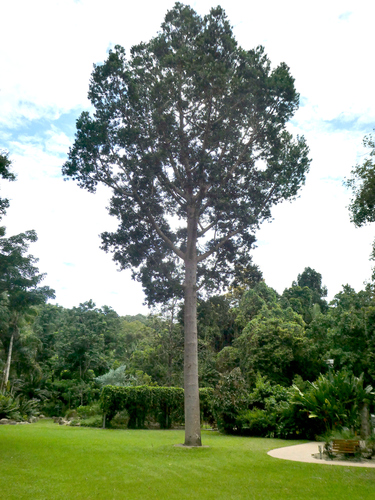
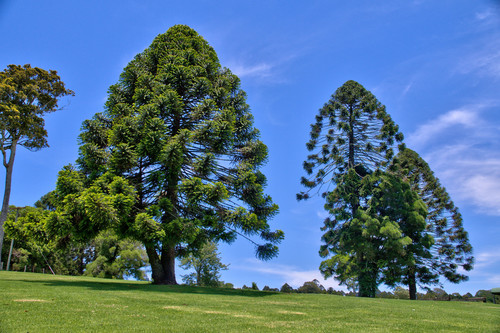
Araucaria bidwillii Hook. can reach 50 m (160 ft) in height, with a single unbranched trunk up to 1.5 m (4 ft 11 in) in diameter covered in dark brown or black flaky bark. Branches grow in regular whorls along the trunk, with crowded leaf-bearing branchlets at their ends. Most branches are held roughly horizontally: upper trunk branches tend to be slightly ascending, while the lowest trunk branches tend to droop slightly, giving the tree a very distinctive egg-shaped silhouette. Leaves are small, rigid, and have a sharp tip that can easily penetrate skin. They are narrowly triangular, broad at the base, and sessile (without a stem). They grow up to 5 cm (2.0 in) long by 1 cm (0.4 in) wide, with fine longitudinal venation, are glossy green on the upper surface and paler underneath. Leaf arrangement is both distichous and decussate, also called secondarily distichous: one pair of leaves grows opposite each other on the twig, and the next pair above is rotated 90° around the twig, repeating this pattern. Cones are terminal; male pollen cones are spiky and grow up to 20 cm (7.9 in) long, maturing between October and November. Female seed cones are much larger, reaching up to 30 cm (12 in) long and 20 cm (7.9 in) wide, around the size of a rugby ball. When mature between December and March, female cones are green and have 50–100 pointed segments, each enclosing one seed, and can weigh up to 10 kg. Both pollen and seed cones are among the largest of all conifer species. The edible seeds, called bunya nuts, are 2.5 cm (1.0 in) to 5 cm (2.0 in) long and shaped ovoid to long-elliptic. At the start of British occupation of Australia, A. bidwillii was abundant in southern Queensland, where it grew in large groves or scattered regularly as an emergent species in other forest types along the upper Stanley and Brisbane Rivers, the Sunshine Coast hinterland (particularly the Blackall Range and Maleny), and around and on the Bunya Mountains. Two additional small, highly isolated natural populations occur roughly 1,500 km (930 mi) further north, in the wet tropics region of northeastern Queensland: one near Cannabullen Falls on the Atherton Tableland, and the other in Mount Lewis National Park. Today, within the species' former range in southeast Queensland, populations only exist as very small groves or isolated individual trees, except on and near the Bunya Mountains where the species is still fairly common, while the north Queensland populations remain stable. The limited current distribution of A. bidwillii in Australia is partly a result of poor seed dispersal, and partly the long-term drying of the Australian continent over millions of years, which has reduced the area of suitable climatic zones for rainforest. For this species, pollen cones form in April and mature in September or October. Cones require fifteen months to mature, and fall 17 to 18 months after pollination, between late January and early March, from coastal areas to the current Bunya Mountains. Pollination timing can change during periods of heavy rainfall or drought. Multiple species of birds and mammals eat A. bidwillii seeds, including sulphur-crested cockatoos (Cacatua galerita), short-eared possums (Trichosurus caninus), fawn-footed melomys (Melomys cervinipes), and wallabies. Sulphur-crested cockatoos also act as seed dispersal agents: they carry seeds to distant perches to consume them, and may drop seeds along the way. It has been reasonably suggested that extinct large animals — first dinosaurs, later Australian megafauna — may also have been seed dispersers for bunya, given the seeds' large size and high energy content, but this idea cannot be confirmed due to the incomplete fossil record of coprolites. A. bidwillii has unusual cryptogeal seed germination: seeds first develop an underground tuber, and the aerial shoot emerges later. Shoot emergence can take place over several years, which is thought to be a strategy that lets seedlings emerge when climatic conditions are optimal, or has been suggested to help seedlings avoid fire. This erratic germination pattern is one of the main challenges for silviculture of this species. In small forestry plantations of bunya pine in Southeast Queensland, introduced red deer (Cervus elaphus) are a problem. Unlike possums and rodents, red deer eat intact bunya cones, which prevents seed dispersal. Bunya nuts germinate slowly. When 12 seeds were sown in Melbourne, they took an average of around six months to germinate — the first seed germinated after three months — and only developed roots after one year. Seedlings' first leaves form a dark brown rosette, and only turn green once the first stem branch develops. Young leaves are relatively soft, unlike the hard, sharp mature leaves. Propagation via cuttings can be successful, but cuttings must be taken from upright growing shoots, because cuttings from side shoots will not grow upright. In Australia's highly variable climate, the variable timing of seedling emergence maximises the chance that at least some seedlings will successfully replace the parent tree. A germination test was carried out by Smith starting in 1999. Seeds were extracted from two mature cones collected from a single cultivated specimen growing in Petrie, just north of Brisbane, on the former homestead of Thomas Petrie, son of the first European to document the species. One hundred apparently full seeds were selected and planted into 30 cm by 12 cm plastic tubes filled with commercial sterile potting mix in early February 1999. The tubes were placed in a shaded location and watered weekly. Four tubes were lost after being knocked over. Out of 100 planted seeds, 87 germinated. Tubes were checked monthly for seedling emergence over three years. Of the germinated seeds, 55 emerged between April and December 1999; 32 emerged between January and September 2000; one seed emerged in January 2001, and the last emerged in February 2001. Once established, bunya pines are quite hardy. They can be grown as far south as Hobart, Australia (42° S) and Christchurch, New Zealand (43° S), and at least as far north as Sacramento, California (38° N), Coimbra, Portugal (in the botanical garden), and even the Dublin area of Ireland (53ºN), where they grow in a microclimate protected from arctic winds and moderated by the Gulf Stream. Cultivated trees reach 35 to 40 metres in height, and live for approximately 500 years.