About Araucaria araucana (Molina) K.Koch
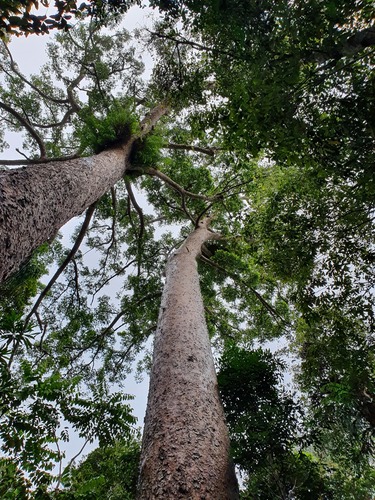
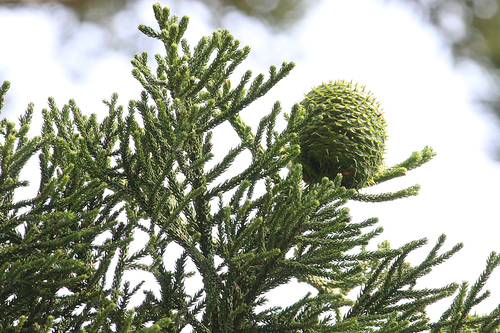
Araucaria araucana (Molina) K.Koch has thick, tough, triangular scale-like leaves. Leaves measure 3–4 cm long, 1–3 cm broad at the base, and have sharp edges and sharp tips. According to a 2001 study by Lusk, leaves stay attached and remain alive for up to 24 years, covering almost all of the tree, with the exception of older branches. The species is usually dioecious, meaning male and female cones grow on separate trees, though occasional individual trees produce cones of both sexes. Male pollen cones are oblong and cucumber-shaped; they start at 4 cm long, and expand to 8–12 cm long by 5–6 cm broad when they release pollen. Pollination occurs via wind. Female seed cones mature in autumn around 18 months after pollination. They are globose and large, with a diameter of 12–20 cm, and hold roughly 200 seeds. The cones disintegrate when mature to release nut-like seeds that are 3–4 cm long. The thick bark of Araucaria araucana can grow up to 15 cm thick, which may be an adaptation to wildfire.
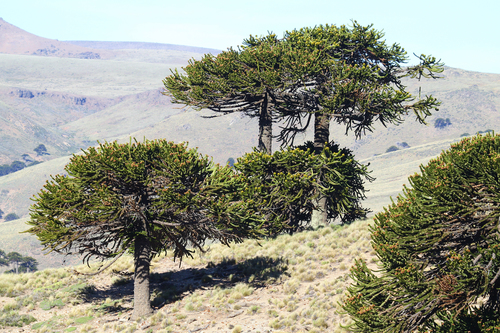
The tree's native habitat is the lower slopes of the south-central Andes of Chile and Argentina, located approximately between 1,000 m and 1,700 m in elevation. In the Chilean Coast Range, A. araucana can be found as far south as Villa Las Araucarias at latitude 38°30' S, at an altitude of 640 m above mean sea level. Juvenile trees grow in a broadly pyramidal or conical shape, which naturally develops into the distinctive umbrella form of mature specimens as the tree ages. It prefers well-drained, slightly acidic volcanic soil, but can tolerate almost any soil type as long as it drains well. Seedlings are often not competitive enough to survive unless they grow in a canopy gap or an exposed isolated area. It is almost never found growing alongside Chusquea culeou, Nothofagus dombeyi, and Nothofagus pumilio, because these species typically outcompete A. araucana.
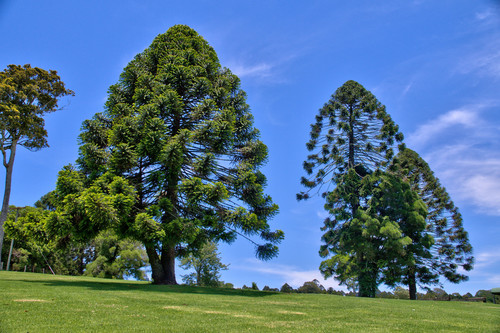
Araucaria araucana is a popular garden tree, planted for the unusual visual effect of its thick, "reptilian" branches with a very symmetrical appearance. It prefers temperate oceanic climates with abundant rainfall, and tolerates temperatures down to approximately −20 °C (−4 °F). It is by far the hardiest member of its genus. It grows well in western and central Europe, reaching as far north as the Faroe Islands and Smøla in western Norway; along the west coast of North America, reaching as far north as Baranof Island in Alaska; and grows locally on the east coast of North America as far north as Long Island. In the southern hemisphere, it grows south of its native range in southern Chile, as well as in New Zealand and southeastern Australia. It tolerates coastal salt spray, but does not tolerate air pollution.
Its seeds, called ngulliw in Mapudungun and piñones in Spanish, are edible. They are similar to large pine nuts, and are harvested by indigenous peoples in Argentina and Chile. The tree has some potential to be a food crop in other areas in the future, since it thrives in climates with cool oceanic summers such as western Scotland, where other nut crops do not grow well. A group of six female trees with one male for pollination can produce several thousand seeds per year. Harvesting is easy because the cones drop from the tree. However, the tree does not produce seeds until it is around 30–40 years old, which discourages investment in planting commercial orchards, even though mature trees can produce immense yields. Once established, individual trees can live over 1000 years. Yields for human consumption and livestock forage fattening from A. araucana mast are limited by pest losses from rodents and feral pigs. The tree has a high degree of inter-year variability in mast volume, and this variation is synchronous across any given area. This trait evolved to take advantage of predator satiety.
The tree was once valued for its long, straight trunk, but its current rarity and vulnerable conservation status mean its wood is now rarely used. It is also considered sacred by some indigenous Mapuche people. Historically, timber from these trees was used for railway sleepers to access many industrial areas around Chilean ports. Before the species became protected by law in 1990, some timber mills in Chile's Araucanía Region specialised in processing its wood, because its durability and resistance to decay made it excellent for producing wood products such as veneers and plywood. The species is protected under Appendix I of the Convention on International Trade in Endangered Species (CITES). This means international trade, including trade in the tree's parts and derivatives, is regulated through the CITES permitting system, and commercial trade in wild-sourced specimens is prohibited.
In the 19th century, plant collector William Lobb brought many young specimens and seeds of Araucaria araucana back to England. While in Chile, he collected thousands of seeds from the Araucanía Region while working for Veitch Nurseries, which is based in Exeter, England. Chris Page, a University of Exeter botanist affiliated with the Camborne School of Mines (CSM), planted Araucaria araucana specimens in disused china clay pits near St Austell, as part of his research into regreening former extractive mining sites. He presented this research in 2017 in the UK Parliament, with Professor Hylke Glass, also of CSM, as co-author. Araucaria araucana is locally naturalised in Great Britain; for example, many young self-sown trees grow at Kyloe Woods in Northumberland.