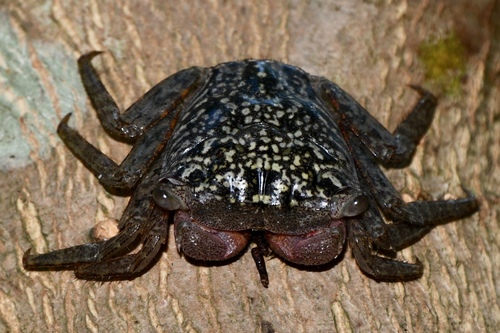
About Aratus pisonii (H.Milne Edwards, 1837)
The mangrove tree crab, scientifically named Aratus pisonii, is a small crab species. On average, males measure around 2 cm (0.8 in) long, while females are slightly smaller. It has large eyes set far apart, and its carapace is wider at the front than at the back. Its coloration is mottled brown and olive, which provides camouflage that helps it blend into its surroundings. Its legs are either solid brown or mottled, with tufts of black hairs located near the tips. The leg tips are pointed, a trait that helps the crab climb through mangrove foliage. This species occurs in tropical and semitropical coastal regions of North, Central, and South America. On the Atlantic coast, its range stretches from Florida to northern Brazil, and covers the entire Caribbean region. It primarily lives on the red mangrove Rhizophora mangle, but is also frequently found on the white mangrove Laguncularia racemosa and the black mangrove Avicennia germinans. It climbs up into mangrove trees when the tide rises, and descends to exposed mud when the tide falls. The mangrove tree crab is an omnivore, though mangrove tree leaves from its host habitat make up the largest part of its diet. It eats the leaf epidermis, leaving distinct scraping marks at feeding sites. Even when this crab is uncommon, its feeding can account for over 90% of total herbivory on mangrove leaves. It also consumes organic debris, algae, decaying mangrove root tissues, and the feces of other members of its own species. It feeds opportunistically on carrion and small invertebrates, including polychaete worms, nematodes, and foraminiferans. Feeding trials have found that the species prefers animal food over plant food. This preference is not surprising because mangrove leaves have low nutritional value, but the large proportion of leaf matter in the crab's diet is unexpected. This diet pattern may be a response to higher predation risk in water compared to the mangrove canopy. Predators of the mangrove tree crab include birds, terrestrial mammals, and larger crabs. The crab is good at avoiding predators: it can move along branches at 1 meter per second, and leap into the water below to escape. However, if it enters the water, it may be hunted by predatory fish. In northern Brazil, the breeding season is extended, but reaches its peak during the rainy season. After fertilization, females carry their eggs under their abdomens until the eggs are ready to hatch. While carrying eggs, females move to the edges of mangrove areas, where conditions are more suitable for embryo development and for releasing newly hatched larvae into the sea. Over the course of one month, larvae develop as plankton through four zoeal stages and one megalopa stage.