About Aratinga pertinax (Linnaeus, 1758)
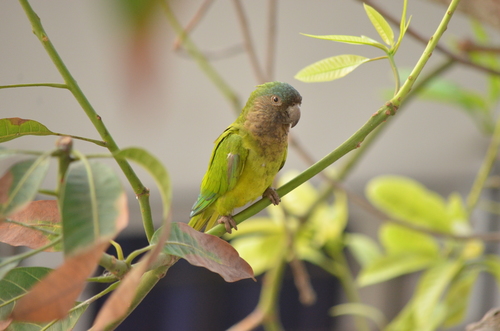
The brown-throated parakeet, also known by the scientific name Aratinga pertinax (Linnaeus, 1758), measures 23 to 28 cm (9.1 to 11 in) in length and weighs 76 to 102 g (2.7 to 3.6 oz). Males and females have identical appearance. Adults of the nominate subspecies E. p. pertinax have yellow coloration on the forehead, face, and chin. Their crown, nape, and upperparts are green. Their breast is dull olive, and their belly is grass green with an orange patch at its center. Their wings are mostly green, with dull blue edges and tips on the flight feathers; their tail feathers are also green with dull blue edges and tips. Immature birds have very little yellow plumage. Other subspecies differ from the nominate in the following ways: E. p. ocularis has an olive-brown face; E. p. aeruginosa has a buff forehead and orange-yellow crown and nape; E. p. griseipecta has a buff forehead, orange-yellow crown and nape, and olive-gray cheeks and breast; E. p. lehmanni has a buff forehead and orange-yellow plumage on the crown, nape, and area around the eye; E. p. arubensis has a yellow face with some brown mixed in; E. p. xanthogenia has an orange-yellow crown and nape; E. p. tortugensis has a buff forehead and orange-yellow crown, nape, and sides of the head; E. p. margaritensis has a whitish forehead and olive-brown face; E. p. venezuelae has a whitish forehead, olive-brown face, and yellowish upperparts; E. p. surinama has a whitish forehead, rich brown face with orange below the eye, and a greener breast; E. p. chrysophrys has a whitish forehead and rich brown face; E. p. chrysogenys is darker than all other subspecies and has entirely green forehead and crown; E. p. paraensis is darker than all subspecies except chrysogenys and has an orange-yellow belly. Each subspecies of brown-throated parakeet has the following distribution: E. p. ocularis is found in southwestern Costa Rica, and Panama from the Costa Rica border to Panamá Province; E. p. aeruginosa is found in northern Colombia and Zulia in northwestern Venezuela; E. p. griseipecta is found in the Sinú Valley of northeastern Colombia, and is possibly extinct; E. p. lehmanni is found in eastern Colombia and Amazonas state in southwestern Venezuela; E. p. arubensis is found on Aruba, Leeward Antilles; E. p. pertinax is found on Curaçao, Leeward Antilles; E. p. xanthogenia is found on Bonaire, Leeward Antilles; E. p. tortugensis is found on La Tortuga Island off northern Venezuela; E. p. margaritensis is found on Margarita Island off northern Venezuela; E. p. venezuelae is found in northern and central Venezuela; E. p. surinama is found from northeastern Venezuela through the Guianas; E. p. chrysophrys is found in Bolívar state in southeastern Venezuela, southwestern Guiana, and Roraima in adjacent northern Brazil; E. p. chrysogenys is found in the middle basin of the Rio Negro in northwestern Brazil; E. p. paraensis is found in the Tapajós and Cururu river basins in Pará, north-central Brazil. The nominate subspecies of the brown-throated parakeet was introduced to Saint Thomas, U.S. Virgin Islands, and had established a population there by the 1860s. It spread from Saint Thomas to Culebra Island, Tortola, and Puerto Rico, but was extirpated from all these locations by around 1982. More recent sightings in Puerto Rico, as well as sightings in Florida, the British Virgin Islands, Anguilla, Dominica, and San Andrés, are known or suspected to be of escaped or released cage birds, rather than the result of deliberate introductions or natural range expansion. This species is a non-breeding visitor to Trinidad. The brown-throated parakeet lives in a wide variety of landscapes, including savannas, arid scrublands, mangroves, tropical deciduous forests, gallery forests, evergreen forests, cultivated areas, and pastures with scattered remaining trees. In Colombia, it can be found at elevations up to 2,600 m (8,500 ft), but across the rest of its range it occurs mostly below 1,200 m (3,900 ft). It is widely distributed in Venezuela, but prefers areas with open vegetation, and has higher probabilities of being found in the savannas of the Llanos bioregion and the arid scrublands of northwestern Venezuela.