About Aratinga holochlora (P.L.Sclater, 1859)
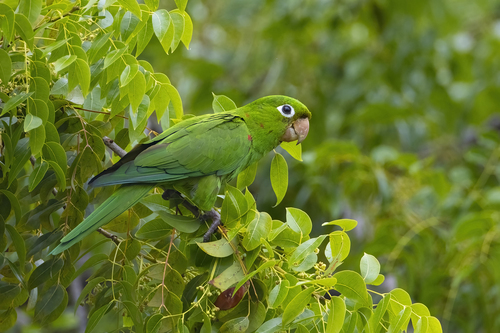
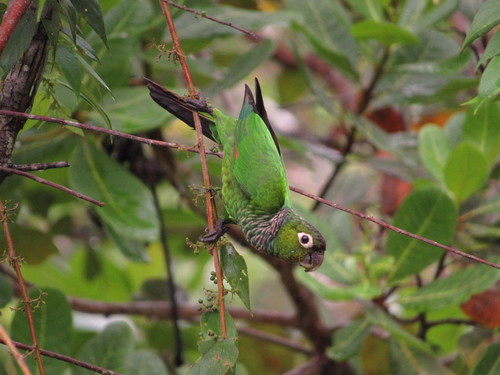
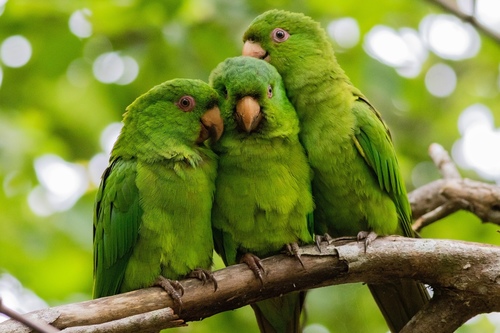
The green parakeet, with the scientific name Aratinga holochlora (P.L.Sclater, 1859), measures 28 to 30.5 cm (11 to 12 in) in length and weighs approximately 230 g (8.1 oz). Males and females are identical in appearance. Adults of both recognized subspecies are generally green, with paler, yellower green coloration on their underparts. Their cheeks and throat have varying amounts of red speckling. Their underwing coverts are yellowish green, while the undersides of their flight feathers and tail are olive-yellow. Their iris is orange-red, surrounded by bare pale beige skin; their bill is horn colored, and their legs and feet are brownish. The subspecies P. h. brewsteri is overall somewhat darker than the nominate subspecies, and has a slight glaucous cast on its head.
In terms of distribution and habitat, the nominate subspecies of green parakeet is native to eastern Mexico, ranging from Nuevo León and Tamaulipas south to Veracruz. The subspecies P. h. brewsteri is found in the northwestern Mexican states of Sonora, Sinaloa, and Chihuahua. Within the United States, this species has an established population in Texas's lower Rio Grande Valley. The origin of this sub-population is unknown, but it may derive from introduced individuals or arrive via natural dispersion. Reported sightings in California, Florida, and New Mexico are thought to be of escaped or released cage birds, and the species is not formally recorded on those states' species lists. Within its native range, the green parakeet lives in semi-open landscapes, including deciduous woodland, gallery forest, and scrublands. It avoids humid lowland forest, and is typically found at elevations between 500 and 2,000 m (1,600 and 6,600 ft). In Texas, it also occurs within cities and towns.