About Aratinga chloroptera (Souance, 1856)
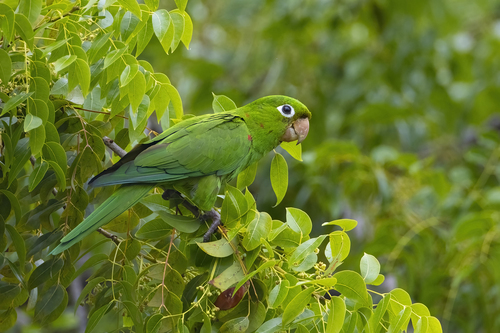
The Hispaniolan parakeet (Aratinga chloroptera) is 30 to 33 cm (12 to 13 in) long and weighs 144 to 147 g (5.1 to 5.2 oz). Males and females have identical plumage. Adults are mostly green, with a more yellowish tone on their underparts. Some adults have a small number of red flecks on their head. The bend and edge of the wing, as well as the outermost underwing coverts, are red. The undersides of the flight feathers and tail are dull yellowish. A ring of bare white skin surrounds the eye. Immature birds have little to no red coloring on their wings. The Hispaniolan parakeet formerly ranged across most of the island of Hispaniola. As of 2020, in the Dominican Republic, the species is found mostly in the Cordillera Central, the Sierra de Bahoruco, and a small number of urban centers. It is very rare in Haiti; in the early 2000s, it was recorded in the Chaîne de la Selle and Massif de la Hotte, with scattered additional records from other parts of the country. This species has been introduced to Puerto Rico and Guadeloupe. There are no eBird records from Puerto Rico, and only very few eBird records from Guadeloupe. The Hispaniolan parakeet lives in a wide variety of landscapes, including lowland forest, montane forest, savanna, open woodlands, secondary forest, croplands, and urban centers such as Santo Domingo. It is most common in humid montane forest. Its elevation range extends from sea level up to 3,000 m (9,800 ft).