About Aratinga canicularis (Linnaeus, 1758)
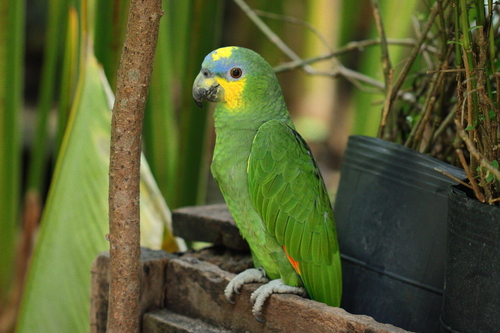
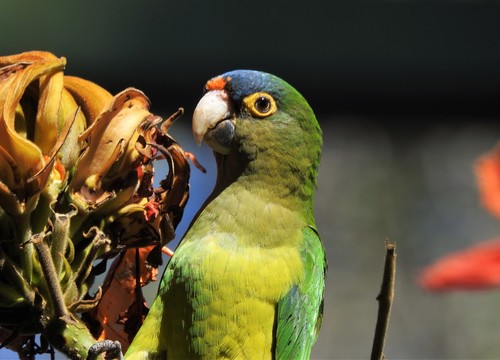
The orange-fronted parakeet, with the accepted scientific name Aratinga canicularis (Linnaeus, 1758), measures 23 to 25 cm (9.1 to 9.8 in) in length and weighs 68 to 80 g (2.4 to 2.8 oz). Males and females have identical plumage. Adults of the nominate subspecies A. c. canicularis have an orange-peach forehead (the "front") and lores, dull blue midcrown, and dull green hindcrown, nape, and back. A ring of bare yellow skin surrounds each eye. Their throat and breast are pale olive brown, and the rest of their underparts are yellowish green. Their wings are green with bluish flight feathers. The upper surface of their tail is green, and the underside is yellowish. Immature birds resemble adults, but have far less orange coloring on the forehead. Subspecies A. c. clarae has a very narrow orange band on the forehead, greener coloring on the throat and breast than the nominate subspecies, and a black spot on the mandible. Subspecies A. c. eburnirostrum also has a narrow orange band on the forehead, is greener on the underparts than the nominate, and has a brown spot on the mandible. The three subspecies of orange-fronted parakeet have distinct ranges: A. c. clarae occurs in western Mexico, from Sinaloa and Durango south to Michoacán; A. c. eburnirostrum occurs in southwestern Mexico, from Michoacán to Oaxaca; A. c. canicularis occurs along the Pacific coast from Chiapas in southern Mexico, through Guatemala, Honduras, El Salvador, and Nicaragua, into northwestern Costa Rica, and has been introduced to Puerto Rico. The orange-fronted parakeet lives in a variety of landscapes, most of which are semiopen to open. These habitats include forest edges, deciduous woodlands, Pacific swamp forest, savanna, and thorn scrub. It is also found in pastures with scattered trees, and in plantations of palms and fruiting trees including mangoes and bananas. It is primarily a lowland and foothill species, but can be found at elevations as high as 1,500 m (4,900 ft) above sea level.