About Araschnia levana (Linnaeus, 1758)
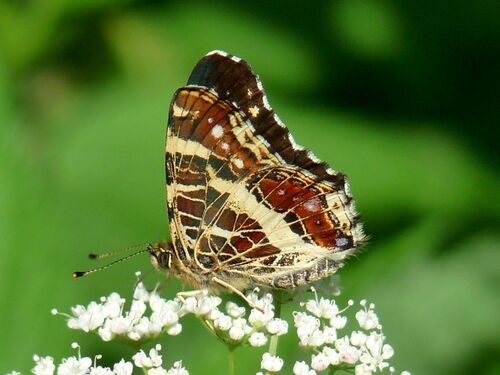
This species, Araschnia levana (Linnaeus, 1758), has a spring first brood with the following wing pattern, as described in Seitz. The upperside of the wings has a reddish ochreous base color with a characteristic spot pattern. The forewing has some whitish subapical and distomarginal spots, while the hindwing has a row of blue bars near its distal margin. The underside of the forewing is generally similar to the upperside, but the apical area has violet dusting, the ground color is paler, and the cell-spots have sharply defined white lines. Most of the hindwing underside is red-brown, with a pale transverse band in the center that widens toward the back. Light lines cross parts of the wing, there is a dull violet smear in the distal area, and both wings have thin black lines along their margins. Rare specimens of this spring brood differ: the black basal and costal markings merge, both wings have dark margins, and central wing markings are fully or nearly gone, leaving these areas almost uniformly red-brown. This variant is ab. frivaldszkyi Aigner. The summer brood flies from July to August, and a third brood sometimes occurs from September to October. This later generation is fundamentally different, and is known as ab. prorsa L. (64d). On the upperside, the wings are black: the forewing has white spots, the hindwing has a white transverse band. Most of the underside is red-brown, with whitish lines and bands. Faint reddish yellow lines appear along the distal margin of the upperside. Specimens where these lines are absent or only faintly visible in places, with narrowed white markings, are called ab. obscura Fruhst. (64f). If the white marking is narrowed to a yellowish stripe, or the entire hindwing is black, the variant is named ab. schultzi Pfitzn. Specimens that completely lack white bands on the upperside, with or without small distal spots, are named ab. weismanni Fisch., a variant that can be produced artificially. On the other hand, individuals with partly yellowish bands and strongly developed reddish yellow distal markings are named ab. intermedia form. nov. (64d). This variant is not rare in nature, and is especially common during wet, cold summers. It forms a transition to ab. porima O. (64d), which is already changed enough toward the spring brood form that reddish yellow color forms the ground color of the distal area, while the bands from prorsa are still visible. Finally, ab. diluta Spul. is an artificially produced variety that resembles porima, but its forewing has an archaic Nymphalidian feature: a row of spots that recall the ocelli found in Satyrids. All these forms are connected by intermediate gradations. prorsa is considered the more recent form; exposing prorsa to cold can change it into the ancestral levana form, but the reverse change does not happen. The egg of this species is ovate, flattened at the top, ribbed, and greenish. Larvae feed gregariously on Urtica dioica. They are black or pale brown with black stripes, sometimes have a reddish side-line, and are covered with short branched thorns that are black, sometimes yellow. The pupa is brown with blackish spots. The projections on the head and back are obtuse, and the pupa sometimes has metallic spots. The pupa of the last brood hibernates. The species' distribution extends from Spain through Europe and east across the Palearctic to Central Asia, the Russian Far East, Korea, and Japan. It is found across Central and Eastern Europe (except England), ranging south to Dalmatia, and continuing through Armenia, Siberia, Amurland, and Ussuri. In Japan, the species apparently has three broods. Variants reappear in the eastern part of the range, with no striking or consistent differences from variants found in the West.