About Arapaima gigas (Schinz, 1822)
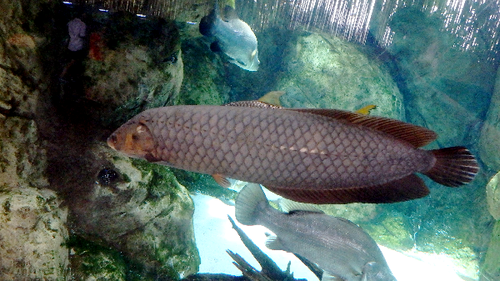
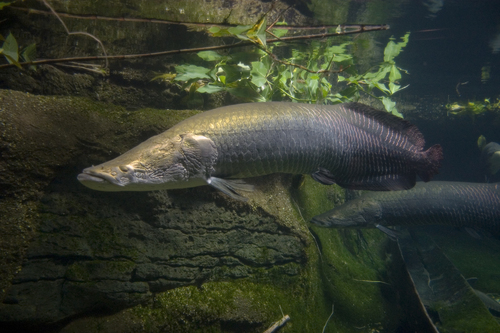
Arapaima gigas (Schinz, 1822) ranks among the largest known freshwater fish. Commonly, individuals measure 200 cm (79 in), and exceptional reports note it can reach lengths up to 450 cm (15 ft). Adult individuals may weigh as much as 200 kg (440 lb). Typically, the head makes up 10.3% to 12.8% of the fish's total body weight. It is an ancient fish that belongs to a group of primitive carnivorous bony-tongued fishes. A. gigas has a streamlined body, with its dorsal and anal fins placed well back toward the tail. Most of its body is colored gray to gray-green. Its local Brazilian name, pirarucu, comes from an indigenous term meaning "red fish." This name is thought to refer to either the red flecks on the fish's scales near the tail, or the reddish-orange color of its meat. After sexual maturation, male A. gigas typically develop red coloration, and up to 70% of a mature male's total body can display this red coloring. The fish have flexible, armor-like scales that consist of a hard, mineralized outer layer and a tough-but-flexible inner layer. These scales protect the fish from attacks by piranhas. Scales are usually 5–7cm long, but can reach 10cm in larger individuals. They are built from layered collagen fibers, and overlap across the body to form this armor-like structure. A. gigas is native to freshwater habitats in the Amazon River basin and the Tocantins-Araguaia river basin in Brazil, and it is native to both Brazil and Peru. In Bolivia and Peru, it is called paiche. In most parts of Bolivia, it is considered an invasive species that harms local native species and ecosystems. Small additional populations have been found in Peru's Iquitos region, and in four distinct rivers across Ecuador, Colombia, and Guyana. Populations of A. gigas are growing and becoming more common in its non-native range, but populations are rapidly declining in its native range. A. gigas was first introduced to Peru's Madre de Dios region for aquaculture in 1976. Within about a decade, arapaimas reached Bolivian waters, because the Madre de Dios basin connects to Bolivia's Beni River. Rising water in aquaculture ponds allowed the fish to escape into the local watershed and establish self-sustaining populations outside of containment. Currently, 70 registered distribution points for A. gigas exist in Bolivia, including small rivers, lagoons, and streams located between the Beni River and Peru's Madre de Dios River. Historical reports of arapaima sightings first began north near the Peru border, then sightings moved downstream as populations established and spread across new areas. In less than 30 years, the species invaded the entire Madre de Dios and Beni watersheds. The species has also been introduced to parts of East Asia, both intentionally for fishing and accidentally. It also spreads through ornamental aquaculture, and is commonly traded as a pet in Europe, North America, South America, and Asia. Fish farms for A. gigas operate in Thailand and Malaysia, and the species is especially prominent in the Java and Sumatra regions of Indonesia. Studies have recorded single individuals found in freshwater or dead in shallow water in introduced areas outside these farms. One record documented 22 total individuals in Surabaya, Indonesia's second largest city. A 13-million-year-old fossil of an arapaima, or a very closely related species, has been found in Colombia's Miocene epoch Villavieja Formation. In its native range, A. gigas lives in flooded forest areas, where it reproduces during the wet season. When water levels drop, the fish move to lakes.