About Araneus marmoreus Clerck, 1757
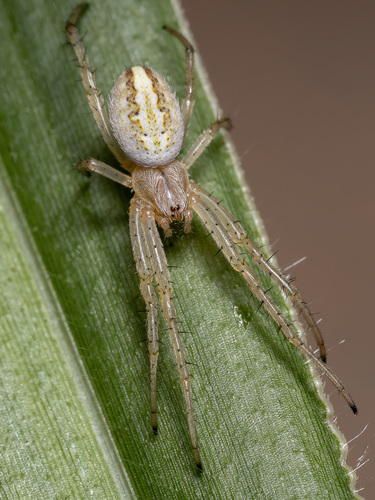
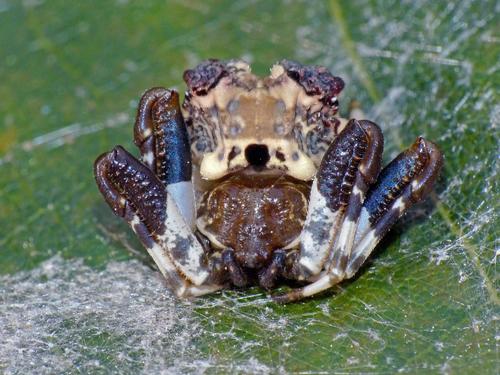
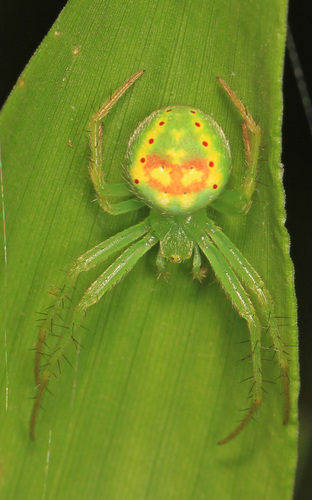
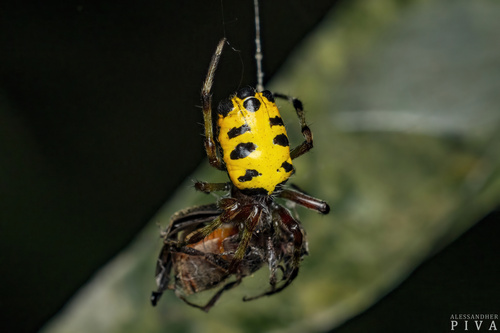
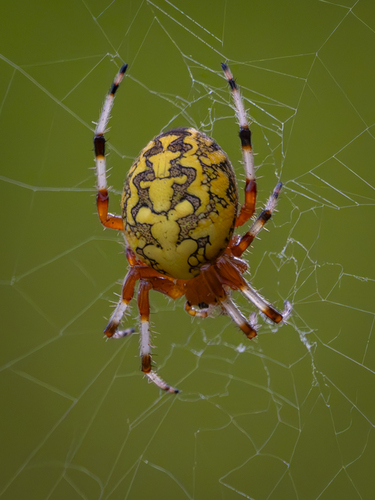
Araneus marmoreus Clerck, 1757 is commonly called the marbled orbweaver. For adult individuals, adult females reach a maximum body length of at least 14 mm, and have a very large, oval, sub-spherical abdomen. Adult males are smaller, with a maximum body length of 7 mm.
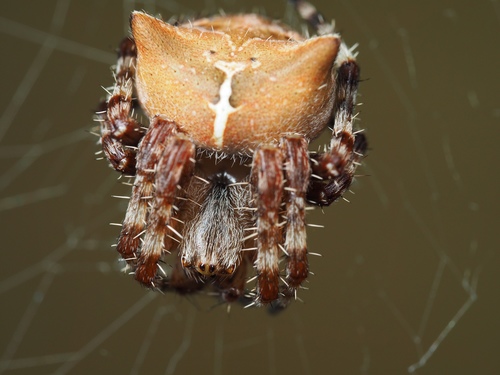
The species has two main recognized color forms. A. marmoreus var. marmoreus has an orange abdomen marked with brown to black marbling, and it usually has a distinct folium with dark edging. A. marmoreus var. pyramidatus has a much paler abdomen, with a single dark, often reddish-brown, mark at the rear. Despite these two main forms, the entire species can display a wide range of overall colorations and folium patterns. Var. pyramidatus is more common across Europe, but it is uncommon in North America.
The cephalothorax is typically yellow to burnt-orange, with a central dark line and additional dark lines running down either side. The leg femurs are often red, with black and white banding that begins on the tibia, metatarsus, and tarsus; legs may also have a light brown banded pattern instead. The ventral side of the body has a black band that is enclosed by white bracket-shaped markings.
Egg cocoons of this species each hold several hundred eggs. They are generally laid in October, constructed from white silk and shaped into a flattened sphere. Immature spiders hatch and emerge from the cocoons the following spring. Adult spiders can be seen from midsummer until the first hard freeze of fall.
This species has a Holarctic distribution, ranging from North America through Europe to Japan. In North America, it occurs across the whole of Canada, extends to Alaska and the northern Rocky Mountains, is found from North Dakota south to Texas, and ranges east from there to the Atlantic coast.