About Araneus granadensis (Keyserling, 1864)
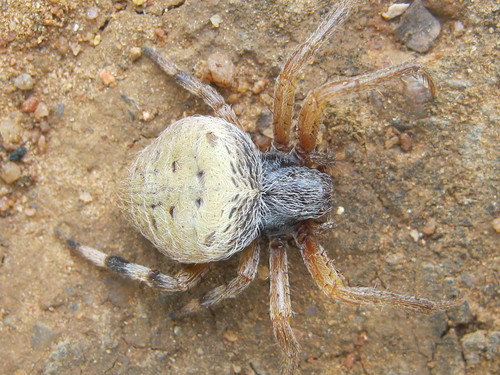
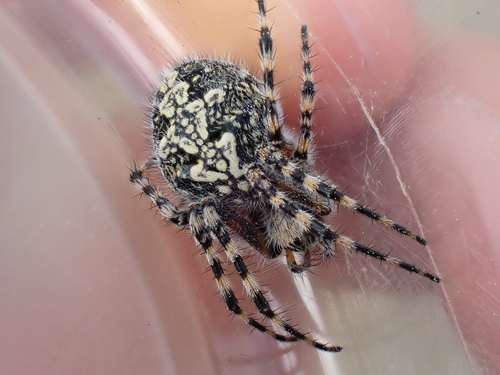
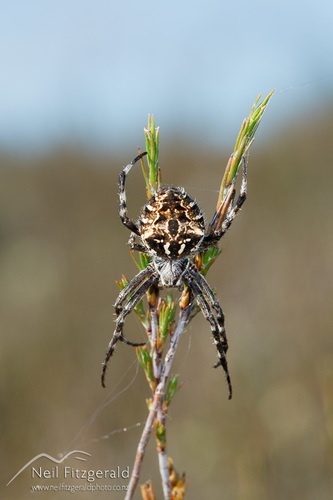
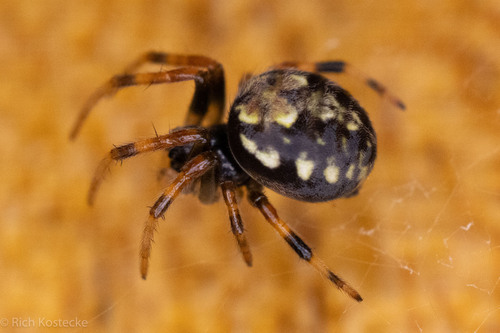
Based on Keyserling's original description of Araneus granadensis, the cephalothorax is usually dark brown with yellow lateral margins, and sometimes has a lighter head region. It is covered in long, fine hairs. The front of the cephalothorax is not quite half as wide as the back, and the structure is somewhat longer than it is wide. Lateral grooves clearly separate the head region from the rounded posterior portion of the cephalothorax. The abdomen is short and egg-shaped, projects slightly past the cephalothorax at the front, and is narrower at the back. Abdominal color ranges from light brown to black, and its pattern is often very indistinct. In specimens with clear markings, a light longitudinal band runs along the upper abdomen, crossed in the middle by two short bands of the same light color, creating the appearance of a double cross. A narrow band runs along each side of the abdomen, and splits into two branches in its posterior half. There is also often a series of yellow spots on each side, visible from the rear crossband to the tip of the abdomen. Males of this species measure 5 to 8.5 mm in total length. They are considerably more slender and smaller than females, with proportionally much longer legs. At least among the four specimens examined by Keyserling, male coloration is much lighter. Males also have a much longer, more densely haired abdomen, and thicker, larger spines on their legs. Araneus granadensis has been recorded in Venezuela, Colombia, Ecuador, and Peru.