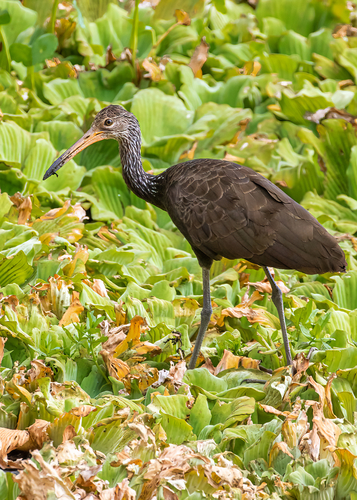
About Aramus guarauna (Linnaeus, 1766)
Aramus guarauna, commonly called the limpkin, is a somewhat large bird. It measures 64–73 cm (25–29 in) in length, with a wingspan of 101–107 cm (40–42 in). Its body mass ranges from 900 to 1,300 g (2.0 to 2.9 lb), with an average mass of 1,080 g (2.38 lb). Males are slightly larger than females in size, but there is no difference in plumage between the sexes. Its plumage is drab: dark brown with an olive luster on the upper side. White markings streak the feathers of the head, neck, wing coverts, and most of the back and underparts excluding the rear, giving the body a streaked appearance and the head and neck a light gray tone. It has long dark-gray legs, a long neck, and a long, heavy, downcurved bill that is yellowish with a darker tip. The bill has a slight opening near, but not at, its tip that allows a tweezers-like action to pull snails out of their shells; many individuals have a bill tip that curves slightly to the right, matching the shape of apple snail shells. First-year birds have slightly less conspicuous white markings. The limpkin has broad, rounded wings and a short tail, and is often confused with immature American white ibis. This species is easier to hear than to see. Its common vocalization is a loud wild wail or scream with a rattling quality, transcribed as "kwEEEeeer or klAAAar." This call is given most often at night, as well as at dawn and dusk. Other vocalizations include wooden clicking sounds, clucks, and a "piercing bihk, bihk..." alarm call. The limpkin's range extends from peninsular Florida (including the Okefenokee Swamp in southern Georgia) and southern Mexico, through the Caribbean and Central America, to northern Argentina. In South America, it is widespread east of the Andes; west of the Andes, its range only reaches as far as the Equator. It lives in freshwater marshes and swamps, often areas with tall reeds, and also occupies mangroves. In the Caribbean, it also lives in dry brushland. In Mexico and northern Central America, it occurs at altitudes up to 1,500 m (4,900 ft). In Florida, the distribution of apple snails is the best predictor of where limpkins can be found. The limpkin makes some localized migrations, though the full extent of these movements is not fully understood. In the northern parts of its range, females and a small number of males leave breeding areas at the end of summer and return at the end of winter. In Brazil, birds that breed in some seasonal marshes leave during the dry season and return when the rains come. Individuals may move between Florida and Cuba, as multiple limpkins have been recorded on the Florida Keys and Dry Tortugas; these records may also represent vagrants or postbreeding dispersal instead of regular migration. A Florida study using wing tags found that limpkins can disperse up to 325 km (202 mi) from their breeding site. This tendency explains why vagrant limpkins have been seen in other parts of the United States and at sea near the Bahamas. Limpkins have recently expanded rapidly across Anglo-America, reportedly due to the spread of apple snails and climate change. Limpkins are active during the day, and also forage at night. Where they are not persecuted, they are very tame and approachable, though they usually stay near cover. They are mostly non-aggressive, unconcerned by other species and rarely fight with other members of their own species. Thanks to their long toes, they can stand on floating water plants. They are good swimmers, both as adults and newly hatched chicks, but they rarely swim. They fly strongly, with their neck held forward and legs held backward; their wings beat shallowly and stiffly, with a jerky upstroke, and are held mostly above horizontal. For breeding, males hold exclusive territories that range in size from 0.15 to 4.0 ha (0.37 to 9.88 acres). In large, uniform swamps, nesting territories often clump together to form large colonies. Males vigorously defend their territories: they fly to territory edges to challenge intruders and chase passing limpkins out of the area. Territorial displays between males at territory boundaries include ritualized charging and wing-flapping. Females may also take part in territorial defense, but usually only against other females or juveniles. Territories may be maintained year-round, or abandoned temporarily during the nonbreeding season, most often due to lack of food. Limpkins may be either monogamous, with one female joining a male's territory, or serially polyandrous, with two or more females joining a single male. Banding studies of monogamous pairs show that a small number of pairs reform the following year, with four out of 18 observed pairs doing so. Nests can be built in a wide variety of locations: on the ground, in dense floating vegetation, in bushes, or at any height in trees. They are bulky structures made from rushes, sticks, or other plant materials. Initially, the male builds the nest within his territory before pair-bond formation. Unpaired females visit multiple territories before settling on a male to breed with. Males may initially challenge and fight off prospective mates, and may not accept first-year females as mates. Pair-bond formation can take several weeks. Courtship feeding is part of the bonding process: males catch and process a snail, then feed it to the female. A clutch holds three to eight eggs, with five to seven being typical for an average clutch size of 5.5. Eggs measure 6.0 cm × 4.4 cm (2.4 in × 1.7 in). Egg color is highly variable: the background color ranges from gray-white through buff to deep olive, and eggs are marked with light-brown and sometimes purplish-gray blotches and speckles. Eggs are laid one per day until the clutch is complete, and incubation is usually delayed until the full clutch is laid. Both parents incubate eggs during the day, but only the female incubates at night. Shift length is variable, but males incubate for longer periods during the day. Males remain territorial during incubation and leave the clutch to chase off intruders; if a male leaves, the female quickly returns to the eggs. The incubation period is about 27 days, and all eggs hatch within 24 hours of each other. Hatchlings are covered in down, and are capable of walking, running, and swimming. They follow their parents to a platform of aquatic vegetation, where they are brooded. Both parents feed the young. Young limpkins reach adult size at 7 weeks old, and leave their parents at about 16 weeks old. Limpkins are attacked and eaten by American alligators. Adult limpkins have been recorded with serious foot and leg injuries, which suggests they may be attacked by turtles while standing on floating vegetation. Their eggs and nestlings are preyed on by snakes, raccoons, crows, and muskrats. During droughts, foraging adult limpkins may experience kleptoparasitism from snail kites; boat-tailed grackles have also been observed attempting to steal apple snails caught by limpkins. Examinations of Florida limpkins for parasites found trematodes, nematodes, and two species of biting lice: Laemobothrion cubense and Rallicola funebris. The trematode Prionosoma serratum was found in the intestines of some birds; this species may infect limpkins after first infecting apple snails, as this route of infection has been confirmed for a closely related trematode that infects snail kites. The nematodes Amidostomum acutum and Strongyloides spp. are also ingested and live in the gut. In Florida, limpkins may be eaten by certain growth stages of multiple invasive snakes: Burmese pythons, reticulated pythons, Central African rock pythons, Southern African rock pythons, boa constrictors, yellow anacondas, Bolivian anacondas, dark-spotted anacondas, and green anacondas.

