About Aramides cajanea (Statius Muller, 1776)
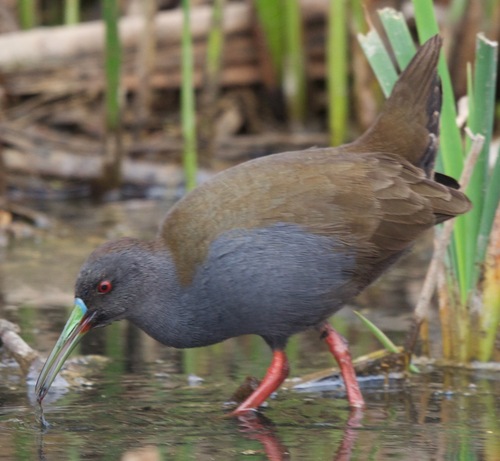
The grey-cowled wood rail, Aramides cajanea (Statius Muller, 1776), is unusually large for a wood rail. Adults typically measure 33–40 centimetres (13–16 in) long and weigh 320–465 grams (11.3–16.4 oz). Adults have olive-green to dark brown upperparts, with medium-grey head and neck that blends into a brown patch on the back of the head. Their eyes are red. The chest and flanks are rufous, while the belly, rump, and tail are black. Legs are coral-red, and the bill is bright greenish-yellow. Males and females have similar appearances. Juvenile grey-cowled wood rails resemble adults but have duller overall coloration, sooty-black bellies flecked with buff, dusky bills and legs, and brownish eyes. Newly hatched chicks are black and downy, with brownish heads. Their dark eyes are bordered by dull, reddish bare skin. The black bill has a flesh-coloured base, with a small white egg tooth behind the tip of the upper mandible, and a very small egg tooth at the tip of the lower mandible. The subspecies A. c. avicenniae differs from the nominate subspecies in being smaller. Its nape to back is dull grey, and the brown patch on the back of the head seen in the nominate is reduced or entirely absent. The lower back has a faint olive tone, underparts are slightly paler than the nominate and lack white feathers, and upper wing-coverts are more greenish-grey. The similar rufous-necked wood rail, which is smaller than the grey-cowled wood rail, can be told apart by its reddish head and neck paired with a grey upper back. Grey-cowled wood rails moult their remiges all at the same time, between the months of March and June. This species is distributed across Argentina, Bolivia, Brazil, Colombia, Costa Rica, Ecuador, French Guiana, Guyana, Panama, Paraguay, Peru, Suriname, Trinidad and Tobago, Uruguay, and Venezuela. The nominate subspecies is separated by the Andes Mountains, occurring east of the Andes in Ecuador, Peru, and Bolivia, and is absent from the southeastern interior of Brazil. The subspecies avicenniae occurs in coastal southeastern Brazil around São Paulo. The natural habitats of the grey-cowled wood rail are subtropical or tropical moist lowland forests, subtropical or tropical mangrove forests, and subtropical or tropical swamps. The avicenniae subspecies is almost entirely restricted to mangrove forests. The species occurs from sea level up to around 2,000 metres (6,600 ft), though wandering individuals have been recorded as high as 2,300 metres (7,500 ft) in Colombia. Like other forest rails, the grey-cowled wood rail can perch in shrubbery and even trees. It rarely flies; if flushed, it typically moves to a low, close branch. It is generally cautious when observed.