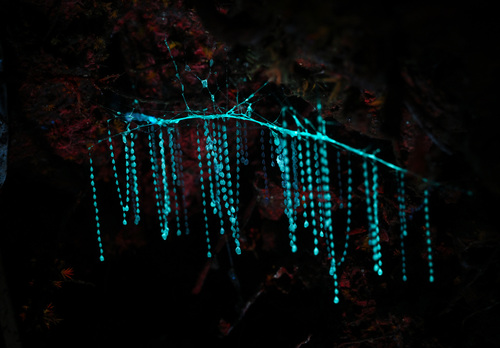
About Arachnocampa luminosa (Skuse, 1891)
Arachnocampa luminosa (Skuse, 1891), commonly called the New Zealand glowworm or simply glowworm, is a fungus gnat species endemic exclusively to New Zealand. Both its larval stage and adult imago form produce blue-green bioluminescence. This species lives in caves and on sheltered banks in native New Zealand bush with high humidity, because moisture is required to maintain the silk structures it uses to capture prey. It has two Māori names: pūrātoke, which comes from the Māori verb meaning "to glow", and titiwai, which translates to "lights reflected in water". This second name likely refers to the species' habit of living near bodies of water, where their glowing displays produce visible reflections. Arachnocampa luminosa is widespread across both the North Island and South Island of New Zealand. Populations are typically found in cave systems and native bush where prey is available and humidity remains high. They take shelter in caves or crevices that provide consistent darkness and protect their silk prey snares from air currents, positioned near thick mud or still water where their insect prey can breed. Several locations with large glowworm populations have become popular tourist destinations: these include the caves at Waitomo, Waipu, Inglewood, and Te Ana-au, as well as areas of native vegetation like the Wellington Botanical Gardens. The temperature and humidity levels inside Waitomo Caves are unusual compared to other caves at temperate latitudes. Comparisons of climatic data from 1955 and the 1977–1980 period show that the cave's climate was more stable in 1955 than it is today. This increased climatic variability is thought to be the result of the cave entrance being unblocked in 1975, which caused the cave to act as a wind tunnel. The first written record of this species dates to 1871, when a specimen was collected from a gold mine in New Zealand's Thames region. Initially, scientists thought the species was related to the European glowworm beetle, Lampyris noctiluca. In 1886, a teacher from Christchurch demonstrated that it was actually the larva of a gnat, not a beetle. The species was first formally described in 1891 under the name Bolitophila luminosa, and was placed in the family Mycetophilidae. In 1924, it was moved to its own separate genus, Arachnocampa, because the wing venation of adult individuals and the behavior of larvae differ significantly from other fly species in the genus Bolitophila. The spherical eggs of A. luminosa are 0.75mm in diameter, and are usually laid directly onto cave walls. After hatching, cylindrical larvae begin glowing immediately. Newly emerged larvae are 3 to 5 millimeters long, and grow to 30 to 40 millimeters over the course of several months. Larvae may move across the surface of their cave or bank before settling on a site to start building their silk nest. Most larvae hatch in spring. Observation of pupal and adult behavior confirms that the larval stage is the longest life stage of A. luminosa, and can last up to one full year. The larva spins a silk nest on cave ceilings, then hangs down up to 30 silk threads, placing small sticky droplets along these threads at regular intervals. Most of its prey is small Diptera, especially midges, though glowworms that live on banks may also trap spiders and other non-flying invertebrates. After going through five larval instars, the larva suspends itself on a long thread and pupates over a period of up to 24 hours. The pupal stage lasts around two weeks. Pupae continue to glow through this stage, though male pupes eventually stop glowing. Adult glowworms are poor fliers and usually emerge in winter. Adult females live up to 76 hours, while adult males live up to 96 hours. Females typically lay more than 100 eggs, which hatch after approximately 20 days.

