About Ara militaris (Linnaeus, 1766)
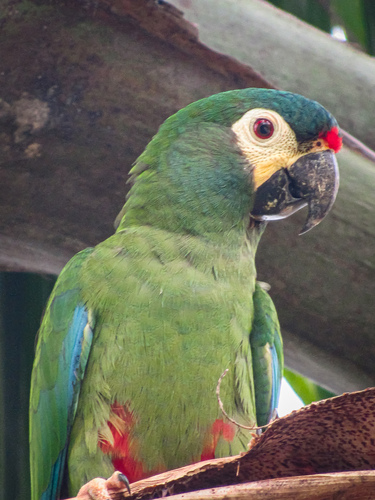
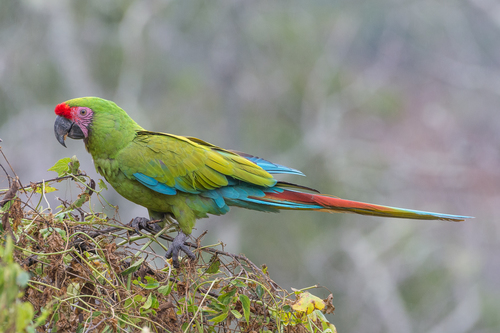
On average, military macaws (Ara militaris) measure 70 to 85 centimeters (28 to 33 inches) in length, with a wingspan ranging from 99 to 110 centimeters (39 to 43 inches). Their plumage is mostly green, with light-blue and yellow feathers on the flight wings and tail, and a bright red patch on the forehead. Like most macaws, they have a bare facial patch that is whitish with black striations. Their large, strong bill has a slate-grey, blackish color, and their iris is yellow. Military macaws look very similar to great green macaws, but can be told apart by their smaller size, entirely black bill, and overall darker, deeper plumage. The two species can also be distinguished by differences in their calls and communication; great green macaws prefer humid forest habitats, while military macaws are most often found in deciduous forests. Phylogenetic studies confirm that the two species are sister clades. Subspecies of military macaw differ from one another in size and coloration. Overall size varies between 70 and 80 cm (28–31 in), with the nominotypical A. m. militaris being the smallest subspecies, and A. m. mexicana the largest. Military macaws typically live in tropical deciduous and semi-deciduous forests. They are a canopy-dependent species, because they require large canopy trees in deciduous and subdeciduous forests for feeding, breeding, nesting, protection from predators, and shelter from heat. They generally occur at elevations between 600 and 1500 m, which is higher in mountain ranges than most other macaw species. However, these macaws may seasonally descend to lowlands, where they are most often found in humid forests and thorny woodlands. They nest in the tops of trees 8–28 m off the ground, and more frequently nest on cliff faces over 600 ft (180 m) above the ground. The three recognized subspecies of military macaw are separated geographically. A. m. militaris occurs in Bolivia, Peru, Ecuador, Colombia, and Venezuela. A. m. mexicana is found in Mexico, while A. m. boliviana lives in Bolivia and Argentina. The species’ absence from Central America may be explained by local habitat changes and competition with the closely related great green macaw. Escaped or deliberately released military macaws have been recorded in Florida, USA, but there is no evidence of an established breeding population; the recorded individuals likely persist only from ongoing releases or escapes. Around dawn, military macaws leave their roosts in flocks to forage. Their diet is mostly made up of seeds, and also includes fruits and leaves. They have been observed drinking water from Pseudalcantarea grandis and consuming latex from Plumeria rubra. They have a relatively narrow diet, meaning they only feed on a small percentage of the plant species available to them. They gather in flocks to feed on accumulations of clay called "macaw licks" located along riverbanks, and sometimes in the interior of the Amazon rainforest. The clay deposits are thought to neutralize toxins found in the seeds and vegetation that make up the rest of their diet, and also provide dietary salt that is otherwise missing from their diet.