About Ara macao (Linnaeus, 1758)
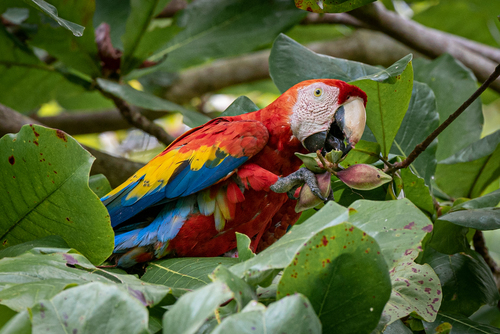
Ara macao, commonly called the scarlet macaw, measures approximately 84 centimeters (33 inches) in total length. More than half of this length consists of the pointed, graduated tail that is characteristic of all macaws, and the scarlet macaw has a larger proportion of its total length made up by the tail than other large macaw species. Its average weight is around 1 kilogram, equal to 2 pounds 3 ounces. Most of its plumage is scarlet, but its rump and tail-covert feathers are light blue, its greater upper wing coverts are yellow, the upper sides of the wing flight feathers and the tips of the tail feathers are dark blue, and the undersides of the wing and tail flight feathers are dark red with metallic gold iridescence. Some individual scarlet macaws may have green patches on their wings. The Central American subspecies is larger, with an average length of 89 centimeters (35 inches). Bare white skin extends from around the eye to the bill, and the bare facial patch holds tiny white feathers. The upper mandible is mostly pale horn-colored, while the lower mandible is black. Juvenile scarlet macaws have dark eyes, and adult scarlet macaws have light yellow eyes. This species is frequently mistaken for the slightly larger green-winged macaw, which has more prominent red lines on its face and no yellow coloring on its wings. Scarlet macaws produce very loud vocalizations, including high and sometimes low-pitched throaty squawks, squeaks, and screams. These calls can travel many kilometers to communicate with other members of their group. In captivity, scarlet macaws can live up to 75 or even 90 years, though a more typical captive lifespan ranges from 40 to 50 years. The scarlet macaw primarily lives in humid lowland subtropical rain forests, open woodlands, river edges, and savannas. In some regions, scarlet macaws periodically visit natural mineral deposits called licks, which are typically rich in clay and sediment. The macaws eat this material to aid digestion and obtain essential nutrients including sodium and calcium. The species has an extensive native range across South America, covering most of the Amazon basin and the rainforest of the northern half of the continent, extending as far south as Peru east of the Andes, and Bolivia. In northeastern Bolivia's Beni Department, near Riberalta, the capital of the Bolivian Amazon region, it is quite common in the Aquicuana Reserve. In southern North America and Central America, the species' range extends from the Yucatán Peninsula in extreme southeastern Mexico and Belize, and southward through Guatemala, El Salvador, Honduras, and Nicaragua, and also includes the island of Coiba. The species is rarely seen on mainland Panama, but it occurs in isolated regions along Costa Rica's Pacific coast, mainly near the Nicoya Peninsula, Carara National Park, and the Osa Peninsula. In Florida, United States, scarlet macaws have escaped captivity multiple times throughout history, either accidentally due to hurricanes or other severe weather, or through deliberate release by humans. There is no evidence that this non-native population is established and breeding, and it likely only persists due to ongoing new releases or escapes. These non-native birds are probably sustained by intentional feeding from local residents who enjoy having them visit their yards. The species is also an introduced species in Puerto Rico. A small introduced population exists in Kirkby Stephen, Cumbria, after being introduced to the area around 2010. This population includes a number of related blue-and-yellow macaws, and the birds are trained to fly freely around the area, returning to a local conservation centre for food and shelter each evening.