About Ara ambiguus (Bechstein, 1811)
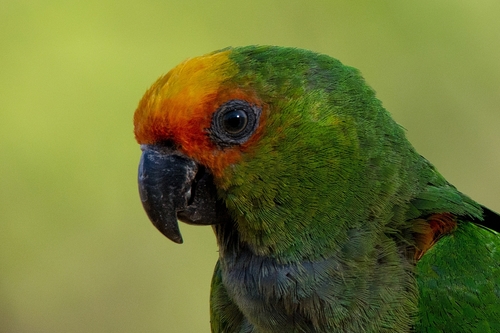
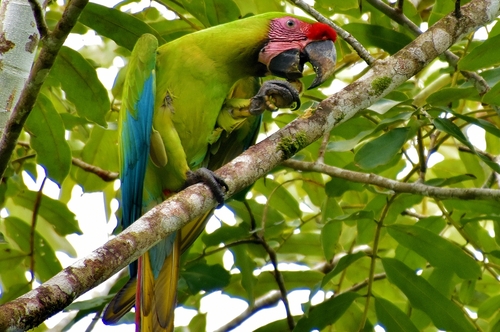
Ara ambiguus, commonly known as the great green macaw, is the largest parrot in its natural range, the second heaviest macaw species, and the third heaviest parrot species worldwide. It is relatively shorter-tailed than other large macaws like the red-and-green macaw, resulting in a shorter overall body length. On average, this species measures 85–90 cm (33.5–35.5 in) in length and weighs 1.3 kg (2.9 lb). Its plumage is mainly green, with a reddish forehead, pale blue lower back, rump, and upper tail feathers. The tail is brownish-red and tipped with very pale blue. Its bare facial skin is patterned with lines of small dark feathers, which are reddish in older and female parrots. Juvenile great green macaws have grey eyes instead of black, duller overall plumage, shorter tails, and yellow tail tips. The subspecies Ara ambiguus guayaquilensis is mainly distinguished by its smaller, narrower bill. Where the ranges of great green macaw and military macaw overlap, the two species look superficially similar and are easily confused. Great green macaws inhabit tropical forests. Their native range includes the Atlantic wet lowlands of Central America from Honduras to Panama and Colombia, as well as Pacific coastal lowlands of Panama, Colombia, and western Ecuador in South America. In western Ecuador, they also occur in seasonal deciduous dry tropical forests. In Colombia, where the great green macaw and the closely related military macaw both live, the great green macaw prefers more humid woodlands than the military macaw. In Costa Rica, the breeding habitat of the great green macaw is practically non-seasonal evergreen rainforest, which receives rain for around ten months of the year, has an annual precipitation of 1,500 to 3,500 mm, and maintains an average annual temperature of 27 °C. During the breeding season in Costa Rica, great green macaw habitats are dominated by almendro (Dipteryx oleifera) and Pentaclethra macroloba, with secondarily raffia palm (Raphia spp.)-dominated wetlands. In Costa Rica, great green macaws are usually observed below 600 m above sea level during the breeding season, but disperse to elevations as high as 1000 m after breeding, and can be seen as high as 1500 m in southern Panama. The Ecuadorian great green macaw population is thought to be split into two disjunct areas on the country’s western coast: one in the Cordillera de Chongon coastal mountain range in southwestern Ecuador, and another in far northern western Ecuador bordering Colombia, in Río Verde Canton of central coastal Esmeraldas Province, stretching east into Imbabura Province. This bird is very uncommon in Ecuador. In Colombia, it is reasonably common in the Darién region and the Gulf of Urabá near the Panamanian border; it is also found in the north of the Serranía de Baudó mountains on the Pacific coast, the West Andes, and eastward to the dry forests of the upper Sinú valley near the Caribbean coast. In Panama, it is common in some areas including the Caribbean slope and parts of Darién National Park such as the Cana birdwatching site, across the Alto de Nique mountain, and the adjacent border with Colombia; it is also found in the Serranía de Majé mountains near Panama City and the southern Cerro Hoya mountains. In the early 2000s, the great green macaw’s reproductive range in Costa Rica was thought to be restricted to 600 to 1120 km² of very wet forest in the northeast along the border with Nicaragua. After the breeding season, this population disperses in larger groups to higher altitudes both south into Costa Rica’s central cordillera and north into Nicaragua. By 2007, another population was recorded in inland hills between Old Harbour and Sixaola near the northern Panamanian border. In Nicaragua, populations exist in the country’s east in the Bosawás, Indio Maíz Biological Reserve, and San Juan reserves. In eastern Honduras, it occurs in areas including the Río Plátano Biosphere Reserve, where it is rare. Historically, this macaw had a larger range: specimens were collected in Limón, Costa Rica in 1924, around Matagalpa, Nicaragua in 1904 and 1907, and in Almirante, Panama in 1927. This is a rare introduced species in Singapore, where individuals can be seen on Sentosa island and in Ang Mo Kio Town Garden West. From 1994 to 2000, a large study using radio telemetry was launched by George V. N. Powell and carried out by a team of researchers to improve knowledge of the natural history of the great green macaw in Costa Rica. The main objectives of the study were to determine the home range of Ara ambiguus, characterize the habitats it frequents, and collect more information on its feeding habits, ecological associations, abundance, reproduction, and nesting habits. The breeding season of the great green macaw runs from December to June in Costa Rica, and from August to October in Ecuador. In Costa Rica and Nicaragua, the great green macaw usually nests in Dipteryx oleifera, the most common large tree species in the area; one 2009 study of 31 nests found this species was used for nesting 87% of the time. Other tree species used for nesting include Vochysia ferruginea, Carapa nicaraguensis, and Prioria copaifera, plus one unidentified species. Older studies have also recorded nesting in Albizia caribea and Carapa guianensis, in addition to Vochysia ferruginea. Different tree species are used for nesting in Guatemala. Nest trees are generally quite tall, averaging 32.5 m in height and reaching up to 50 m, with a diameter at chest height of 75 to 166 cm. Nest cavities have no preferred orientation, and are usually located high up on the trunk, near the tree’s crown. 87% of these cavities form when a large branch breaks off the trunk near the tree’s crown. Multiple pairs have sometimes been found nesting in the same tree; a tree with three active nest cavities has been recorded at least twice. The scarlet macaw has identical nest preferences, and the two species compete for nesting cavities where their ranges overlap. In a few cases, the two species have been found nesting in separate cavities in Costa Rica and Honduras. In one instance, nests were found in the same large dead tree in a forest clearing, which held two great green macaw nests, one scarlet macaw nest, and numerous holes holding nesting Psittacara finschi parakeets, with all these animals apparently tolerating one another. In Costa Rica, nesting occurs from December to June, and most pairs lay their first egg in January. Male great green macaws only produce semen during the breeding season, and the semen has a low sperm concentration. Females lay a clutch of 2–3 eggs and incubate them for 26 days. A single adult (likely the female) incubates the eggs while the other forages for food and feeds the incubating bird. Both parents participate in rearing the young. In Costa Rica, nests contain chicks from February to April; young are usually fully feathered by the end of April, and only rarely by mid-June. Chicks hatch weighing 23 g, can fly after 12–13 weeks, and are weaned after 18–20 weeks when they weigh over 900 g. In the wild, one nest generally produces two surviving young. Chicks eat the same foods as their parents. This species has a high reproductive success rate, with 60% of young surviving to independence. After fledging, juveniles remain with their parents as a family unit for an extended period, and only separate from them gradually. At least in captivity, juveniles reach full maturity after 5 years, and sexual maturity after 6 or 7 years. This species can live 50–60 years, with a maximum recorded lifespan of 70 years. The subspecies Ara ambiguus guayaquilensis has been recorded nesting in a cavity in a dead Cavanillesia platanifolia tree at least once, and shows a preference for living Ceiba trichastandra trees in southern Ecuador. Suitable Ceiba nesting trees have a limbless trunk, and the nest is positioned around 20 m high on the trunk. At least in northern Ecuador, macaws show a preference for using Vitex gigantea for nesting.