About Aquilegia pubescens Coville
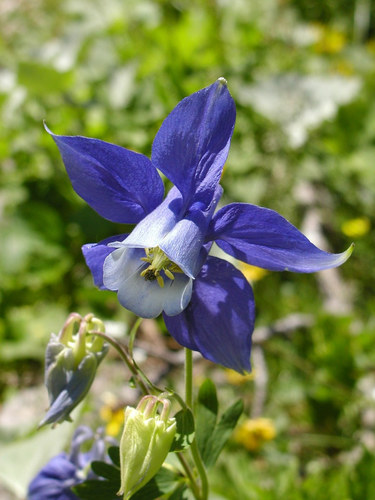
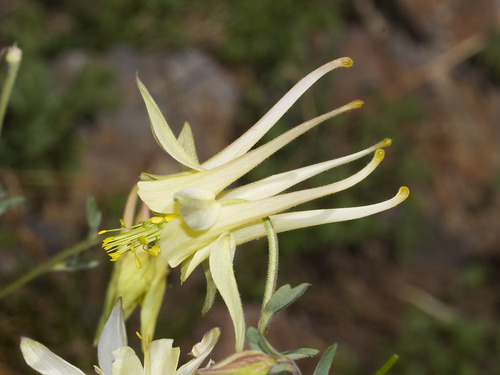
Aquilegia pubescens Coville is a small columbine species that reaches a height of 15 to 50 cm (5.9 to 19.7 inches). Its rootstock is densely covered with leftover leaf remains from previous growing seasons. Stems are mostly hairless, with only sparse hairs near the top. Its leaves are ternate, meaning each leaf is divided into three leaflets. The leaflets are densely covered in fine hairs on their lower surface, with less hair on their upper surface. Each stem produces 2 to 5 flowers that grow erect or spreading, rather than drooping like many other columbine species. The species' characteristic nectar spurs can grow up to 5 cm (2.0 inches) long, and the full flowers can reach up to 5 cm (2.0 inches) across. The sepals and petals are most commonly cream-colored or white, and pink or yellow coloration occurs less frequently. A rounded, fused protrusion forms the flower's mouth, which surrounds a cluster of long yellow stamens. This species is endemic to the High Sierra region of California. A single isolated record from Colorado is thought to be a non-native introduced specimen, not a naturally occurring population. It grows in alpine and subalpine climates, most often on open, rocky slopes, at elevations between 8,000 and 12,000 feet, which equals 2,400 to 3,700 meters. Aquilegia pubescens is pollinated by hawkmoths, and it produces flowers in May and June.