About Aquilegia oxysepala Trautv. & C.A.Mey.
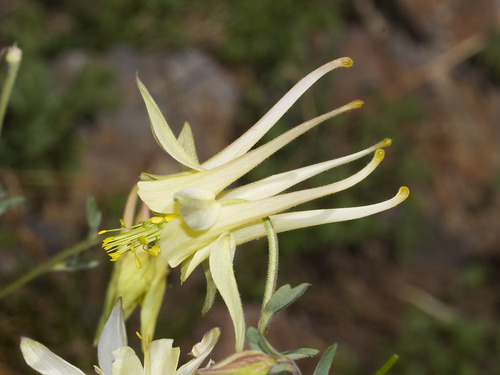
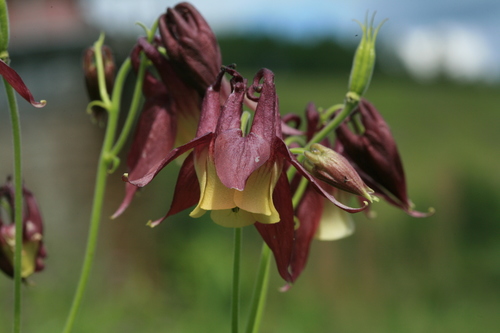
Aquilegia oxysepala Trautv. & C.A.Mey. is a species of herbaceous, perennial flowering plant in the buttercup family, Ranunculaceae. Plants of this species flower in May, and their blooming period lasts three weeks. Most columbine (Aquilegia) flowers generally have five sepals and five petals. In typical Aquilegia petals, each has a broad forward-protruding section called a blade, and an elongated backward-protruding structure called a nectar spur, which holds the flower's nectar. On A. oxysepala, the purple sepals are each ovate-lanceolate in shape and end in an acute tip. Sepals measure between 20 mm (0.79 in) and 30 mm (1.2 in) in length. The blade of each petal is pale yellow to yellowish white, and ranges from 10 mm (0.39 in) to 13 mm (0.51 in) long. The purple nectar spurs are strongly hooked, and reach approximately 20 mm (0.79 in) in length. The overall morphology of A. oxysepala is very similar to that of A. vulgaris. The purple and yellow coloration, plus the acute tips of the sepals and staminodes, are the diagnostic features that distinguish A. oxysepala from A. vulgaris. The seeds of A. oxysepala are approximately 2 mm (0.079 in) long, with shiny black surfaces. Most Aquilegia species are highly interfertile, which allows them to form hybrids. However, research has found that A. oxysepala and the related Asian columbine A. viridiflora do not hybridize with North American Aquilegia species. Polyphenols, mostly flavonoids, are the main components of hydroethanolic extract made from A. oxysepala. These compounds act as antioxidants. One study of A. oxysepala extract found it has good scavenging activity against DPPH, superoxide anion, and hydroxyl radicals, but has poor scavenging capacity against hydrogen peroxide. Ascorbic acid has a stronger scavenging effect than this extract for all of these radicals. Aquilegia oxysepala is native to East Asia, and its native range extends from southeastern Siberia to Japan. This species grows best in temperate biomes. It can be found growing on forest edges and grassy slopes, at elevations between 400 m (1,300 ft) and 2,700 m (8,900 ft) above sea level. In China, A. oxysepala has been used as a dietary supplement and in traditional medicine for thousands of years. It has been used there to treat women's health conditions including irregular menstruation and intermenstrual bleeding. While the antioxidant properties of its extract are confirmed, and its medicinal effects may come from the extract's good superoxide anion radical scavenging activity, the extract is less effective than the common dietary supplement ascorbic acid. Research has also found that A. oxysepala has antibacterial properties. In 1946, American botanist Philip A. Munz reported that A. oxysepala was widely available in cultivation. He noted that garden-grown A. oxysepala specimens were sometimes mislabeled as other species, and that Aquilegia buergeriana was sometimes incorrectly labeled as A. oxysepala var. yabeana.