About Aquilegia eximia Van Houtte ex Planch.
Aquilegia eximia Van Houtte ex Planch. is a perennial herb that grows from a thick caudex, reaching a maximum height between 20 and 160 cm (8 to 63 inches). Lower leaves of the plant are divided into large, leaf-like segments up to 4 to 5 cm (1.6 to 2.0 inches) long, with a lobed oval shape. Leaves positioned higher on the stem are not divided into segments, but may be deeply lobed.
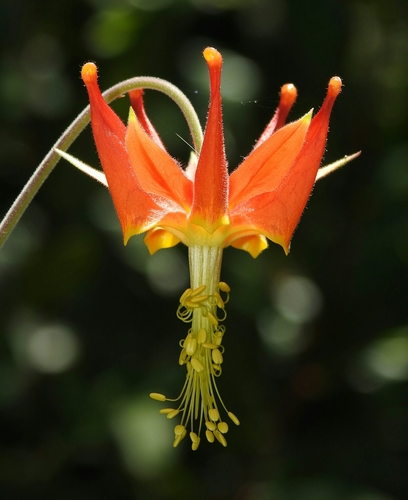
The inflorescence holds a large, nodding columbine flower. Each flower has five bright red to orange-red flat sepals that measure 10 to 28 mm (0.4 to 1.1 inches) long, plus five petals that bear hollow spurs 12 to 35 mm (0.5 to 1.4 inches) long. The spurs are bright orange-red on the outer surface, and lighter orange to yellow on the inside. The opening of each hollow petal tube is 6 to 10 mm (0.24 to 0.39 inches) wide. Sepals and petals are typically reflexed back toward the stem, while five pistils and many thin stamens extend forward from the center of the flower.
Aquilegia eximia is endemic to mixed-evergreen or conifer forests of the California Coast Ranges, the western Transverse Ranges, and the San Francisco Bay Area. It most often grows on serpentine soils, and sometimes grows in moist ravines, at altitudes between 100 and 1,800 m (330 to 5,910 ft). This species flowers from May to October and is pollinated by hummingbirds. Its native range overlaps with the range of Aquilegia formosa, a related species that flowers earlier in the year.