About Aquilegia elegantula Greene
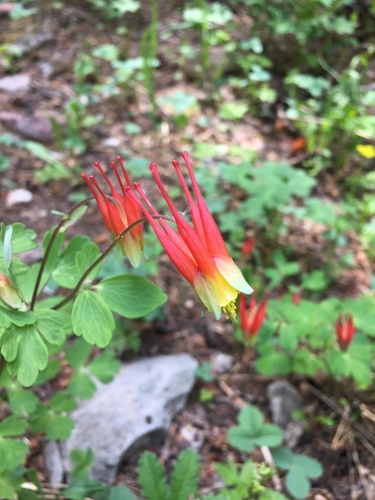
Aquilegia elegantula Greene, commonly known as western red columbine, is a perennial herb. It typically reaches heights between 10 and 60 centimeters (4 to 23.5 inches), though it most often grows 24 to 42 cm (9.5 to 16.5 inches) tall. Basal leaves and stems grow from a caudex that may be either branched or unbranched. Stems may be hairless or pilose, covered in long, straight, soft hairs, but they never have glands. Stems usually bear one or two leaves, but sometimes they have no leaves at all. Most of the plant's leaves are basal, growing directly from the base of the plant; the entire basal leaf structure measures 15 to 30 centimeters (6 to 12 inches) long, and is unusually shorter than the plant's stems. Leaf petioles (leaf stems) measure 6 to 21 cm (2.4 to 8.3 inches). Each leaf is first divided into three parts, and each of these parts is further subdivided into three leaflets, giving nine leaflets per leaf overall. The upper surface of the leaflets is hairless and green, while the underside is glaucous, blue-gray from natural plant waxes. Each leaflet measures 16 to 33 millimeters long by 16 to 37 mm wide, and is shaped cuneate-obovate, meaning it has a tear-drop outline with a triangular base. All leaflets have rounded corners and are deeply divided into three sections. The flower has an overall length of 3 to 3.5 cm (1.2 to 1.4 inches), including the elongated, knob-tipped spurs that grow on each of its five petals. These flowers reflect very little ultraviolet light and have no scent. The spurs of the petals are bright red, fading to yellow-green or orange at the petal tips. Between the petals are oval-shaped sepals, which range from reddish to yellowish in color and are held parallel to the petals. Flowers most often droop, with the opening of the flower facing the ground and the spurs pointing upward. Western red columbine is very similar in appearance to desert columbine (Aquilegia desertorum) and Canadian columbine (Aquilegia canadensis). It grows just north of the range of the desert-adapted Aquilegia desertorum in Utah and western Colorado, and its flowers are much narrower than those of Aquilegia canadensis. This species is native to the Four Corners region of the United States (Utah, Colorado, New Mexico, and Arizona), as well as the northern Mexican states of Coahuila and Nuevo León. It occurs naturally at elevations between 1,500 and 3,500 meters (4,900 to 11,500 ft). It grows in moist Douglas fir and spruce–fir forests, in riparian areas near streams or other water courses, directly from rock faces, and on subalpine slopes. Its flowers are pollinated by the broad-tailed hummingbird (Selasphorus platycercus). Aquilegia elegantula produces 3.9 microliters of nectar per flower per day, more than the 2.45 microliters per day produced by Aquilegia micrantha, so it is likely a more attractive flower to hummingbirds when both species grow in the same habitat. Some bees practice nectar robbing on this species, cutting holes into the narrow flower spurs to access nectar. While desert columbine (Aquilegia desertorum) is more commonly planted in gardens, western red columbine is sometimes sold by plant nurseries for home garden use. It is planted in rock gardens and used as a hummingbird-attracting plant in mountain gardens. When cultivated, it requires partial shade unless watered generously.