About Aquilegia canadensis L.
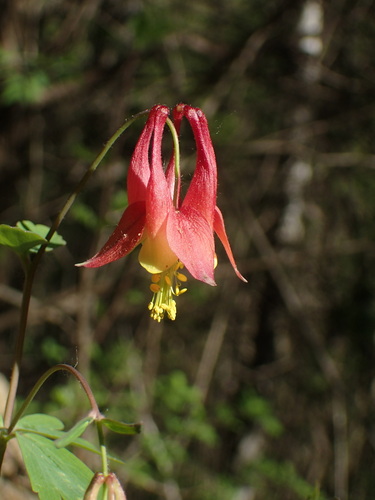
Aquilegia canadensis L. is an herbaceous perennial plant. It typically reaches 15–90 cm (5.9–35.4 in) in height, with branching stems growing from a tap-rooted base. Its fern-like leaves are lobed, arranged in groups of three, and grow from both the plant base and flowering stems. Leaf color ranges from green to blue-green, and leaves stay evergreen except when temperatures rise above 43 °C (109 °F) or drop below −23 °C (−9 °F); in these extreme conditions, the plant goes dormant until temperatures return to a favorable range. The plant grows from a caudex, a vertical underground stem that produces woody rhizomes. This species occurs naturally in partly to fully shaded woodland environments, and thrives in sandy or limestone-based soils. It prefers soil with a pH between 6.8 and 7.5, and cannot tolerate prolonged sun exposure, which can stunt growth and burn leaves. It also does not grow well in overly rich soils, as these encourage excessive growth that leads to weaker stems and shorter plant lifespan. When grown in suitable conditions, Aquilegia canadensis generally has a long lifespan, and has high tolerance for both drought and cold temperatures. It is native primarily to eastern North America. Flowers of Aquilegia canadensis open in late spring, from May to June, and last for around one month, though blooming timing varies based on environmental conditions. Each flower has five yellow petals, each extended into a long, red, nectar-bearing spur, alternating with five red sepals. Numerous yellow stamens sit beneath the corolla, and the entire inflorescence is held above the plant’s basal foliage. The flowers produce abundant nectar that attracts hummingbirds, bumblebees, and hawkmoths. The ruby-throated hummingbird (Archilochus colubris) is the primary pollinator of this species across eastern North America, though bees and moths also contribute to pollination. In each flower, anthers and stigmas are herkogamous; this trait plays a major role in the species’ mixed mating system, determining whether the flower will self-fertilize or outcross. When pollinators are absent, Aquilegia canadensis can produce a full set of seeds through self-pollination, providing reproductive assurance for small or isolated populations. Flowers with greater separation between anthers and stigma have much higher outcrossing success and lower selfing rates, meaning herkogamy reduces self-fertilization rates. Variation in herkogamy is driven mainly by pistil length rather than stamen position, and this variation has a significant genetic component, indicating that floral morphology can evolve under selection to balance selfing and outcrossing. After pollination, Aquilegia canadensis produces a cluster of five pod-shaped follicles, each tapering into a long, slender beak. When mature, the follicles split along one side to release many small black seeds. Seeds develop rapidly, reaching maturity approximately two weeks after flowering. Seed-grown plants typically flower in their second year, and natural reseeding allows colonies to persist even though individual plants have a relatively short lifespan. Germination success is improved by a 3–4 week period of cold-moist stratification. Fruit and seed production is influenced by floral morphology and population size: plants with greater herkogamy tend to produce fewer selfed seeds and have higher outcrossing success, while larger populations produce significantly more fruit and seeds than smaller, more isolated populations. Aquilegia canadensis is native to eastern and central North America, ranging from Canada south through the eastern United States. In the United States, it occurs from New England and the Mid-Atlantic region west to the Great Plains, and south to the Gulf Coast, and is recorded in the following states: Alabama, Arkansas, Connecticut, District of Columbia, Delaware, Florida, Georgia, Iowa, Illinois, Indiana, Kansas, Kentucky, Massachusetts, Maryland, Maine, Michigan, Minnesota, Missouri, Mississippi, North Carolina, North Dakota, Nebraska, New Mexico, New Hampshire, New Jersey, New York, Ohio, Oklahoma, Pennsylvania, Rhode Island, South Carolina, South Dakota, Tennessee, Texas, Virginia, Vermont, Wisconsin, West Virginia. In Canada, it occurs in Manitoba, New Brunswick, Ontario, Quebec, Saskatchewan, and British Columbia. This species typically inhabits woodlands, forest edges, rocky slopes, and shaded bluffs. It prefers well-drained, sandy or rocky soil, and thrives in areas with light to moderate shade. It grows best on sites that are not waterlogged or overly nutrient-rich. Its ability to reproduce via both selfing and outcrossing allows Aquilegia canadensis to maintain stable populations across a wide range of habitats. Aquilegia canadensis has a mixed mating system, meaning it can reproduce through both selfing and outcrossing. The species is fully self-compatible, and can produce nearly full seed sets through autonomous self-pollination alone. However, it does not fully compensate for the absence of pollinators, as fruit and seed production decreases when pollinators are not present. This means selfing only provides partial reproductive assurance. A major factor influencing the balance between selfing and outcrossing is the herkogamy of anthers and stigmas. There is genetic variation in the separation of these reproductive structures between different populations: plants with greater separation between anthers and stigma have lower rates of autonomous selfing and are more likely to outcross. This separation is primarily caused by differences in pistil length, rather than differences in the positioning of reproductive structures. The genetic basis of herkogamy variation between populations indicates this trait can evolve through selection to regulate the species’ mating strategies. Pollination is primarily done by the ruby-throated hummingbird (Archilochus colubris), which can reach nectar stored in the flowers’ elongated spurs. Bumblebees, hawkmoths, and other bees also contribute to outcrossing between flowers. Genetic studies comparing Aquilegia canadensis to its sister species, the primarily bee-pollinated Aquilegia brevistyla, have found that the shift to hummingbird pollination is associated with changes to spur curvature, floral pigmentation, and nectar traits. Reproductive success also depends on population size. Plants growing in larger, more densely populated sites produce significantly more fruits and seeds per plant than plants in smaller populations. Spatial isolation alone does not have a large effect on reproductive output, but smaller population sizes reduce opportunities for pollinator visits and outcrossing. Despite this, Aquilegia canadensis maintains stable populations through a combination of outcrossing and selfing, allowing the species to persist in a wide variety of habitats. Aquilegia canadensis is a highly decorative plant, valued for its attractive foliage and showy flowers. For this reason, it is widely grown outside its native range in temperate regions of the Northern Hemisphere. It grows best in light to moderate shade, and prefers well-drained sandy loams, thriving in limestone-based or circumneutral soils. Plants grown in soils that are too moist or too rich may become weak and have shorter lifespans. Although it is a short-lived perennial, it self-seeds very readily, allowing it to persist in cultivation for many years. Seedlings generally flower in their second year, and germination is enhanced by a 3-4 week cold-moist stratification period, which can occur naturally over winter or artificially via refrigeration. Mature plants can tolerate periods of drought, but grow best with consistent moisture. Several cultivars are commonly grown, including 'Corbett', a dwarf form with yellow flowers; 'Nana', which produces only all-yellow flowers; and 'Pink Lanterns', which has pink and white blossoms.