About Aquila rapax (Temminck, 1828)
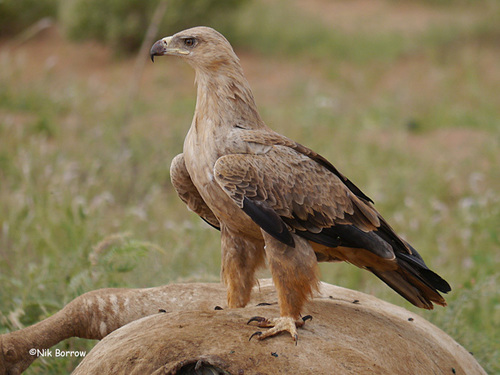
The tawny eagle (Aquila rapax) is often described as "inelegant and scruffy-looking", but it has a fairly characteristic aquiline silhouette. It has a fairly long neck, a long deep bill with a gape line level with the eye, moderately long wings with clearly pronounced "fingers", and a short tail that is slightly rounded to almost square-ended, which looks more similar to a vulture's tail than that of other eagles. Its leg feathering is extensive, often appearing almost baggy. It has a strong, bold bill and head, a well-proportioned body, powerful feet, and a quite fierce countenance. When perching, tawny eagles typically sit quite upright, often staying on stumps, posts, low trees or treetops for most of the day. They may also descend to the ground, where they walk somewhat unsteadily with a more horizontal posture. When perched, their wingtips are roughly even with the tip of the tail. Adults have variably colored eyes, ranging from yellow to pale brown to yellow-brown, while juvenile tawny eagles have dark brown eyes. Both the cere and feet are yellow at all ages. The tawny eagle is polymorphic, with considerable individual variation in plumage that can sometimes cause identification confusion. Adult coloration ranges from uniform dark grey-brown, to occasionally streaky or plain foxy-rufous, to buffish-yellow. Most adults are generally grey-brown or rufous-tawny, with occasional pale spotting visible at close range on the nape and belly, and wing coverts that match the body's uniform tone. The nape is consistently dark and uniform, even though adult feathers are often paler-tipped, and it lacks the contrasting paler feathers commonly seen in other Aquila species. In addition to being slightly larger, females tend to be slightly darker and more heavily streaked than males. The most blackish-brown individuals are most often found in India. Apart from somewhat darker wing and tail feathers, adult coloration usually does not vary much; when freshly molted, great wing coverts and secondaries may have small pale tips that form pale lines along the closed wing. Tawny eagles have tawny upperparts, and blackish flight feathers and tail. The head is usually the same tawny color as the body, but may sometimes have darker eyebrows, thin brown streaks, or a darker chin. The tail is plain or has obscure dark barring, with around 7 subtle bands. Dark morph adult tawny eagles are entirely dark, dull brown. Some worn dark morph tawny eagles may show irregular streaking, or a mix of brown and blackish feathers from molting. Intermediate morph tawny eagles are dark to rufous brown on the upperparts, with the mantle and wing coverts variably streaked or molted to a lighter rufous, which matches the head, with paler crown or crown sides. The underside of intermediate morphs is largely rufous, especially in populations further south in Africa, with the breast and flanks very heavily and broadly streaked dark brown, though it may sometimes appear entirely dark brown, contrasting with plain leg feathers and crissum. Pale morph adult tawny eagles always have a clear contrast between their pale body and wing coverts, and darker flight feathers and tail. In pale morphs, the underparts are rufous buff to light tawny-brown, fading to somewhat darker lesser and median wing coverts, and darker brown to even blackish greater coverts and flight feathers. The head of pale morphs may also be tawny, but sometimes has thin brown streaks or a darker chin. The underparts of pale morph adults are all light rufous to tawny buff or brown, and are sometimes paler below the belly. In worn individuals, the body feathers of pale morph tawny eagles can appear almost whitish. Dark morph juvenile tawny eagles are generally light rufous to rufous brown, with creamier coloring from the lower back to the upper tail coverts. Juveniles have thinly pale-tipped dark brown greater coverts and remiges, while the tail is barred grey and brown, usually with a narrow creamy tip. Dark morph juveniles may fade to pale buff or creamy before molting into browner plumage. Subsequent plumage stages are not as well documented, but it appears dark morph subadults gradually develop darker brown or rufous brown coloration on the mantle, head and upper breast, while retaining a buffish rear body (lower back and rump patch). Other juvenile morphs are generally similar but are less well-documented and may be individually inconsistent. Many are rufous or sandy right after molting, but develop mottling later on; the extent of pale feathers may indicate what their ultimate adult morph will be. In flight, the tawny eagle appears as a large raptor with a noticeably protruding head on a long neck, a deep chest, and long broad wings with a narrower seven-fingered hand. The trailing edge of the wing curves slightly outwards, with an indent at the junction of the primaries and secondaries, while the rounded, medium-length tail is usually held spread. The deep beats of their kinked wings make their flight appear rather heavy and slow, but their wing movements are quicker and more extended, and often less forceful than those of larger Aquila eagles like steppe eagles, and they can be very agile when chasing other raptors to steal their food. Tawny eagles soar with flat or very slightly raised wings, with the wingtips only slightly lowered, and hold the same position when gliding, though they may also arch their wings during a fast glide. Adult dark morphs are more or less uniformly dark brown above and below, with indistinct, slightly paler and greyish primaries on both sides. The main contrast on the upperparts of dark morphs is a paler creamy rump patch, while on the underside, the greyish color contrasts with blackish tips and a diffused trailing edge along both the wings and tail. Intermediate morph tawny eagles have variable rufous streaking on brown to rufous brown back and wing coverts, and share the same contrasting pale rump on the upperparts as dark morphs. Below, the heavy dark streaks of intermediate morphs are only subtly different, so their overall color can appear almost uniform. The wing quills of intermediate morphs are often greyer, with a stronger contrast between paler inner primaries and blackish wing ends. Pale morphs are entirely pale tawny or buffish on both sides of the wings, which contrasts strongly with the distinct dark brown coloring on the greater coverts, flight feathers and tail, and usually the scapulars. The primaries are quite pale on pale morphs, and sometimes have a faint pale carpal comma. Some pale adult pale morphs have pale bases to all underprimaries, and the quills may sometimes be unbarred, but more usually the feathers have dense, narrow dark bars. Dark morph juveniles have a light rufous to pale tawny body on the upperparts, which contrasts strongly with dark brown greater coverts, rear scapulars, flight feathers and tail, which in turn highlights the creamy lower back to tail coverts. Below, dark morph juveniles can look similar to pale morph adults, except for trailing whitish edges and often irregular pale diagonals along the tips of the greater wing coverts, though these usually fade early. Little is known about plumage development for juveniles, but young eagles molt into brown plumage, becoming patchy; intermediate subadults often show 1-3 darker bars on wing linings. The underparts of subadults (around 2 to 3 years old or older) are typically two-toned, with darker brown on the breasts, belly and underwing coverts, while the rest of the underbody is creamy light. This two-toned pattern is seen in subadult tawny eagles from both India and Africa. Tawny eagles reach full adult plumage between 4 and 5 years of age. Tawny eagles have an extremely extensive natural distribution. The African population is split into three fairly discrete groups. One group is found in North Africa, ranging from south-central Morocco (and possibly northern Algeria) through southwestern Mauritania, Senegambia, southern Mali, central and southern Niger, eastward through southern Chad, northern and central Sudan to most of Ethiopia and Somalia, excluding the northeast and central-east. The North African population is scarce. In Morocco, populations have been heavily depleted, with only a few remaining in areas such as Tarfaya, Tan-Tan and Souss-Massa. The species is likely extirpated from Tunisia, where it was once common. In West Africa, some tawny eagles occur in Gambia, Togo, and Nigeria, and may be present (though possibly not breeding) in Ivory Coast and Ghana. In East and Central Africa, the tawny eagle is found in central and eastern Democratic Republic of the Congo, throughout the drier parts of Uganda, and across the entire territory of Kenya, Tanzania, Zambia (where they are often found in the Luangwa valley and Chambeshi drainage), Malawi and Mozambique. In East Africa, it is considered perhaps the most widely distributed and regularly sighted brown eagle. In Southern Africa, the tawny eagle is found throughout Zimbabwe (now rare outside Matabeleland and Chipinga Uplands), Botswana (still regularly seen in the Okavango Delta), parts of Namibia, southern and western Angola (Cuando Cubango, Cunene, Huíla Namibe, to Malanje), Eswatini, Lesotho, and northern and central South Africa, mainly north of the Orange River, though they sometimes range as far south as Cape Province. The tawny eagle is likely extinct as a breeding species in Eswatini, where the last confirmed breeding was in 2001. Outside of Africa, the species may occur in the southwestern Arabian Peninsula, in Yemen and extreme southwestern Saudi Arabia in the Tihamah and 'Asir Regions, but few to no confirmed breeding events have been reported in the last few decades. The tawny eagle is a rare vagrant in Israel; while some sightings are verified, many other reports turn out to be misidentified steppe eagles. It is also a known rare vagrant in Oman. In Asia, the tawny eagle exists as an isolated population in southeastern Iran (where, like in Arabia, no recent verified breeding has been recorded), and is found more continuously in eastern Pakistan (often in the Indus valley), across most of northern and peninsular India, and extends very thinly eastward through southern Nepal and Assam. Though tawny eagles are rarely recorded in Nepal, it is thought the species still resides there in lowland semi-deserts. The Indian range extends from Punjab through the Indo-Gangetic Plain and western Bengal, northeastern Bihar, the Deccan Plateau, and continues south to Andhra Pradesh, Karnataka, and mainly north-central Tamil Nadu. Reports of vagrant tawny eagles in Myanmar, northern Vietnam and Thailand are widely considered to likely be misidentified steppe eagles, or are based on unidentifiable old specimens. A small number of vagrants have been verified in Sri Lanka, marking the only confirmed sighting of an Aquila eagle there. Old unconfirmed reports of vagrancy, which require confirmation, also exist for Afghanistan. Tawny eagles occur in fairly open country at a range of elevations, but usually inhabit drier areas. In West Africa, the species often breeds in relatively moist forest-savanna mosaics, but may move into dry woodlands and semi-deserts when not breeding. In Morocco, the species prefers forested areas near mountains with adjacent plains. Elsewhere in Africa, tawny eagles typically inhabit wooded savanna such as dry Acacia savanna, and semi-desert to desert areas. However, they avoid both extreme desert areas that completely lack tree growth, and humid tropical rainforests. They also sometimes occur in human-modified areas such as arable lands, roadsides, dams, farmland, cattle pastures and game areas if feeding opportunities are available there. In southern Africa, thornveld is often the preferred habitat, with tawny eagles mostly favoring stands of Acacia. Despite similar climate, tawny eagles tend to be much scarcer within miombo woodland. In India, tawny eagles use largely similar habitats, but are also fairly often found near villages and cultivated land, and frequent garbage dumps and slaughterhouses more often than African populations do. In addition to all gradients of arid zones, tawny eagles in India are frequently found around thorn forests. Tawny eagles can live from sea level up to about 3,000 m (9,800 ft), but tend to prefer somewhat lower elevations. Despite the aridity expected in tawny eagle habitats, they normally will not nest unless the habitat meets certain requirements. The presence of tawny eagles depends on the availability of ephemeral rainfall during the wet season. This reliance on some rainfall is probably important for habitat quality, supporting sufficient prey populations, and also for the availability of nesting sites. Tawny eagles are by and large obligate tree nesters, so areas that are too arid to support tree growth, or where trees have been overharvested, are unlikely to host sustained populations of the species.