About Aquila heliaca Savigny, 1809
The eastern imperial eagle (Aquila heliaca Savigny, 1809) is a large eagle, typically around the average size of the Aquila genus. Adult total length ranges from 68 to 90 cm (27 to 35 in), with a wingspan of 1.76 to 2.2 m (5 ft 9 in to 7 ft 3 in). Males are usually smaller than females, with females up to 10% larger linearly and 40% heavier. Males weigh 2.45 - 2.72 kg (5.4 - 6.0 lb) on average, while females weigh 3.26 - 4.54 kg (7.2 - 10.0 lb). In standard measurements, males have a wing chord of 540 - 622 mm (21.3 - 24.5 in), a tail length of 260 - 308 mm (10.2 - 12.1 in), and a tarsus length of 91 - 98 mm (3.6 - 3.9 in). Females have a wing chord of 565 - 665 mm (22.2 - 26.2 in), a tail length of 270 - 330 mm (11 - 13 in), and a tarsus length of 97 - 107 mm (3.8 - 4.2 in). The bill length ranges from 65.7 to 76.5 mm (2.59 to 3.01 in).
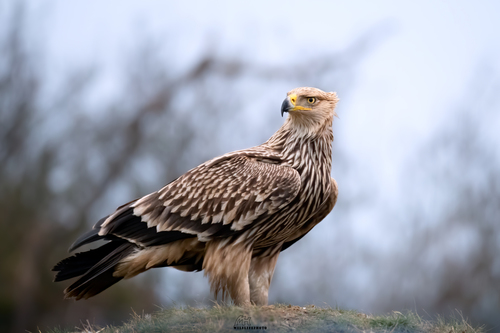
The eastern imperial eagle has a long, thick neck, a big head and bill, a longish square - tipped tail, long and well - feathered legs, and strong feet. It perches upright on exposed branches, mounds, or rocks. Adults have a blackish - brown plumage with a creamy to golden - buff crown, hindneck, and neck sides, and white “epaulettes” on the shoulders. The tail is greyish with narrow dark bars and a broad black subterminal band, sometimes with a white tip. Juveniles are pale tawny - buff to sandy yellow with dark brown streaks, and their scapulars and forewing coverts have white - tipped feathers. By the 2nd year, the streaking fades, and by the 4th winter, they enter subadult plumage. Full adult plumage is attained at 5 - 6 years.
In flight, it has a projecting neck, a “huge” head and bill. The wings are relatively narrow with parallel edges. Its flight style is heavy but steady with deep beats, and it soars with forward - pressed, flat wings. Adults are dark brown above with white braces, and below they are mostly dark with some dusky grey flight feathers. Juveniles are pale buff with brown streaking, and their lower back, rump, and tail coverts are whitish cream.
The breeding range extends from east - central and southeastern Europe across central Russia to the Russian Far East, and south to parts of Georgia, Armenia, Azerbaijan, etc. Isolated populations exist in Turkey, Cyprus, and Iran. It is likely extirpated from Afghanistan and Pakistan.
It is a partial migrant. Migration occurs from September to November in fall and February to May in spring. It overwinters in various regions, including parts of the Middle East, Africa's Nile valley, the Indian subcontinent, and other areas in Asia. Vagrants have been reported in over 20 countries, mainly in Europe.
The eastern imperial eagle prefers open country with scattered trees, woodlands, and areas near wetlands. It breeds in steppe, forest - steppe mosaics, and agricultural lands. It winters in open habitats like grasslands, semi - deserts, and cultivation areas. It resides mainly from sea level to 1,300 m (4,300 ft), locally to 1,800 m (5,900 ft), and has been recorded at 3,900 m (12,800 ft) during passage.
It hunts almost exclusively on the ground. It can hunt from perches, make dives from flight, or capture prey on foot. It may pirate food from other birds and hunt in pairs. Its prey spectrum is highly varied, including 200 - 300 species. Small to medium - sized mammals, especially hares, rodents, and insectivores, are the most common prey. Birds, including young or fledglings of medium - to large - sized species, are also important. Reptiles, fish, and invertebrates are taken less frequently. Carrion is eaten throughout the year, especially in winter. The size of prey ranges from very small invertebrates to large mammals and birds, with most live prey weighing less than 2 kg (4.4 lb). It can also take large prey such as adult hares, large water birds, and young ungulates, and it preys on mammalian carnivorans and small domestic animals.