About Apus apus (Linnaeus, 1758)
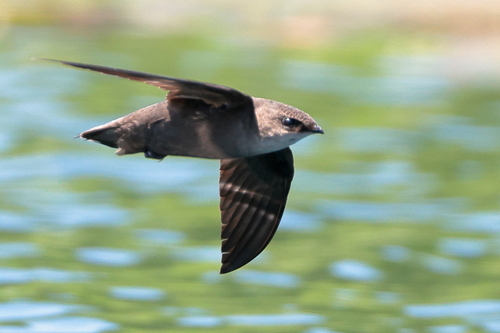
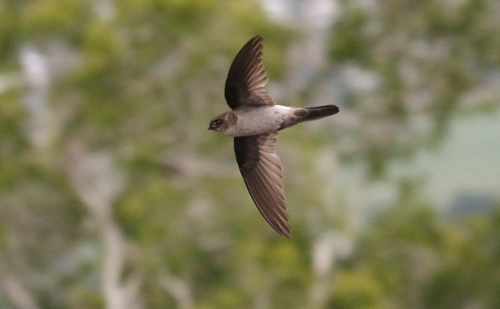
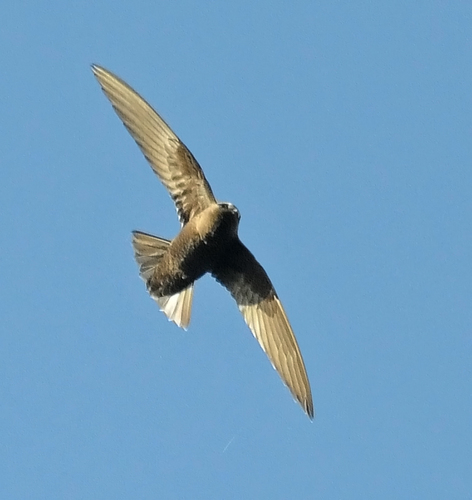
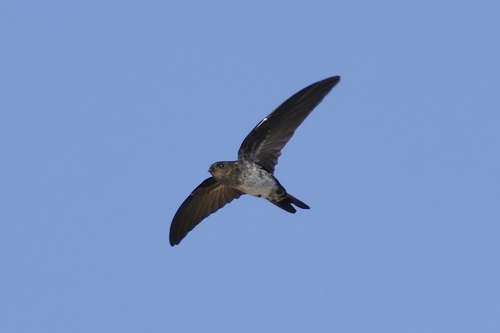
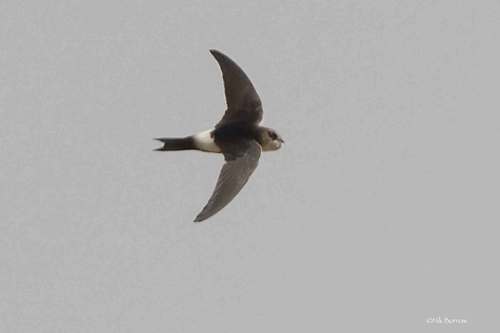
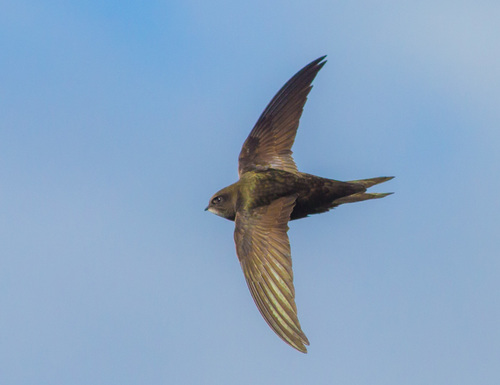
Common swifts, Apus apus (Linnaeus, 1758), measure 16–17 cm (6.3–6.7 in) in length, with a wingspan of 38–40 cm (15–16 in). Their entire plumage is blackish-brown, except for a small white or pale grey patch on the chin that cannot be seen from a distance. They have a short forked tail and very long swept-back wings shaped like a crescent or a boomerang. Their call is a loud scream that occurs in two different tone pitches; the higher pitch call comes from the female. Common swifts often form groups called "screaming parties" during summer evenings, when 10 to 20 swifts gather in flight around their nesting area, calling out and receiving calls in return from nesting swifts. Larger screaming parties form at higher altitudes, especially late in the breeding season. Radar tracking of swifts at their breeding colonies has shown that they often move together in flocks during their evening ascent and dawn descent, but fly separately during the following evening descent and the preceding dawn ascent. This pattern suggests that flocking benefits common swifts through cue acquisition and information exchange between individuals, or through extended social behavior. Common swifts are migratory birds. Their summer breeding range extends from Portugal and Ireland in the west, all the way east to China and Siberia. They breed as far south as Northern Africa, specifically in Morocco and Algeria. They are also present in the Middle East in Israel, Lebanon and Syria, across Turkey in the Near East, and throughout the whole of Europe as far north as Norway and Finland, as well as most of sub-Arctic Russia. Common swifts migrate to Africa via a variety of routes, and spend the non-breeding season in Equatorial and Sub-Equatorial Africa, excluding the Cape region. They do not breed on the Indian Subcontinent. Outside of their normal range, common swifts are rare vagrants in North America; most records of vagrant individuals come from the United States and Canada, though the species has also been recorded in Bermuda and Greenland. It has also been recorded in the Caribbean, on the islands of Bonaire, Barbados, and Puerto Rico. In South America, there are records of the species from Suriname, French Guiana, Brazil, and Colombia.