About Aptychotrema rostrata (Shaw, 1794)
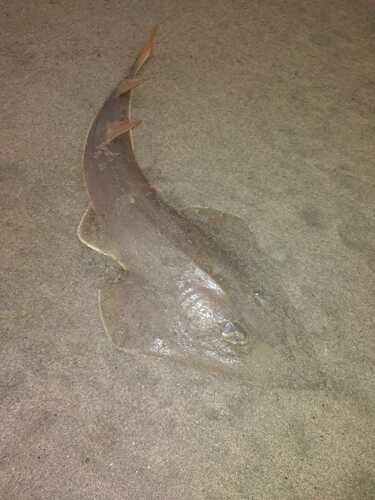
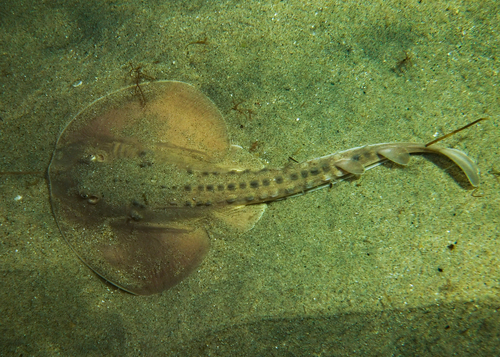
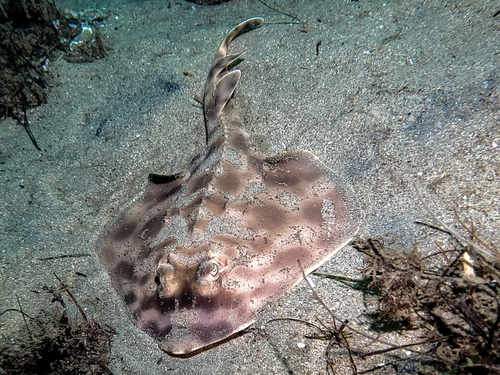
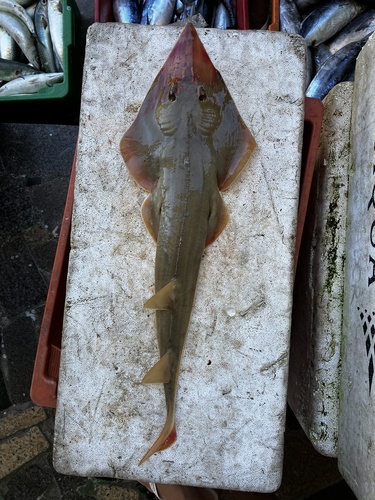
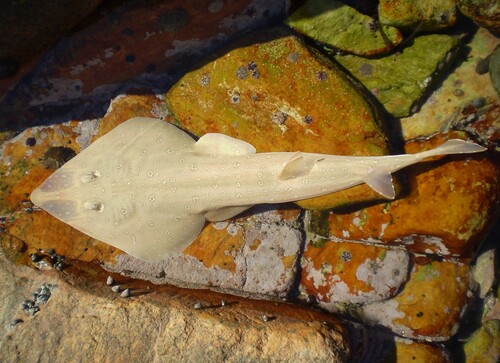
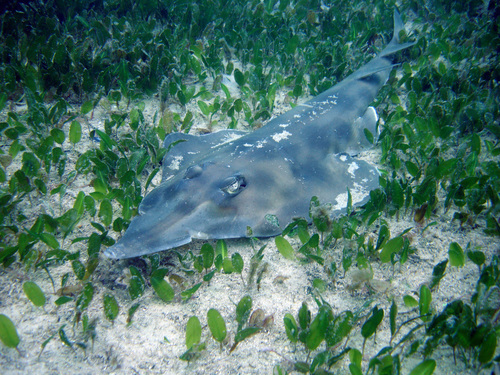
Aptychotrema rostrata, commonly known as the eastern shovelnose ray, is a species of guitarfish belonging to the family Rhinobatidae and order Rhinopristiformes. This species is endemic to the east coast of Australia, where it lives in subtropical and temperate waters ranging from southern Queensland to southern New South Wales. It is a small to medium-sized guitarfish that reaches a maximum total length of 120 cm (47 in). Recent research has found three spectrally distinct cone visual pigments in this species' retinae, which suggests it may have trichromatic colour vision. The eastern shovelnose ray shows sexual dimorphism in tooth and jaw structure: males develop a more pronounced lower jaw, longer and sharper teeth, and greater jaw strength, which allows them to grip a female's fin during mating. The diet of the eastern shovelnose ray is made up predominantly of fish, molluscs, and benthic invertebrates. Eastern shovelnose rays are suction-crushing feeders, and their specific tooth structure and shape let them grind their hard-bodied prey. The eastern shovelnose ray follows a distinct annual and seasonal reproductive cycle: it mates in winter and gives birth to pups in summer. Litter size ranges from 4 to 20 pups, and larger females give birth to more young. The species uses yolk sac viviparity as its reproductive mode: multiple embryos develop at the same time, each connected to a large external yolk sac that provides nutrients, removes waste, and supports respiration. This sac is gradually digested before the young are born. Commercial trawling operations in New South Wales and Queensland report high catch rates of the eastern shovelnose ray. However, limited knowledge of the species' full reproductive biology means its vulnerability cannot be accurately assessed. It is also caught recreationally, and by Indigenous Australians. The eastern shovelnose ray can be sold and consumed as seafood. In terms of distribution and habitat, the eastern shovelnose ray is endemic to Australia's east coast, with a distribution ranging from southern Queensland to southern New South Wales, between 27°S and 36°S latitude. It inhabits subtropical and temperate waters, and most often lives in shallow waters over mudflats and sandflats, as well as in estuaries and on rocky reefs. That said, recent records document specimens collected from depths as great as 220 m (720 ft).