About Apteryx mantelli Bartlett, 1852
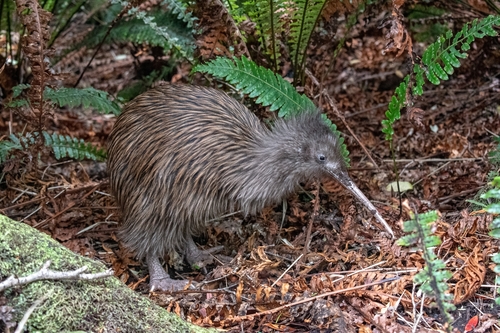
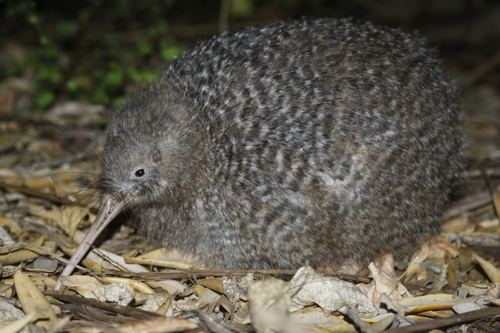
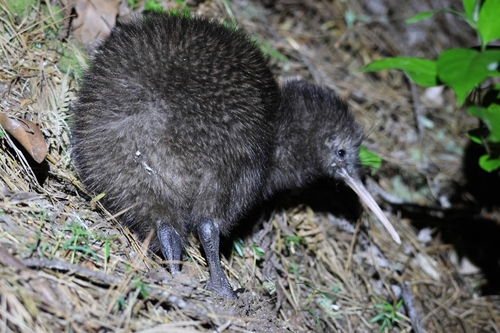
North Island brown kiwi (Apteryx mantelli Bartlett, 1852) display sexual size dimorphism, with females being noticeably larger than males. Females reach about 40 cm (16 in) in height and weigh around 2.6 kg (5.7 lb), while males average about 2 kg (4.4 lb). Their plumage is spiky and streaky red-brown. This is the only kiwi species that is kept in zoos around the world. Outside of sanctuaries and zoos, North Island brown kiwi live in four main regions on New Zealand's North Island: Northland and its associated islands, the Coromandel, eastern North Island, and western North Island. Before human colonisation of New Zealand, most terrestrial land was covered by indigenous forest, which is assumed to have been the primary original habitat for all kiwi species, where they thrived. Today, North Island brown kiwi generally prefer densely vegetated lowland and coastal New Zealand indigenous forest, and their highest population densities occur in these habitats. Widespread deforestation and destruction of these native forests after colonisation has greatly reduced the availability and abundance of this preferred habitat. While traits of North Island brown kiwi including low reproductive rate and longevity suggest the species is adapted to stable environments, it has proven able to adapt to a range of habitat types outside its historical ideal habitat. Brown kiwi also use and live in exotic pine forests, overgrown pasture, sand dunes, regenerating forests, and forest remnants, among other areas. This ability to use varied habitats is thought to come from the kiwi selectively using small patches of favourable or ideal habitat that sit within larger patches of other habitat types. North Island brown kiwi appear to thrive in exotic forests just as they do in indigenous forests. Anecdotal evidence indicates that population density, body weight, and productivity of kiwi in exotic forests are comparable to those in indigenous New Zealand forests. Because this evidence does not come from published data, further research is needed to confirm this observation. Even though the species has a recognised preferred habitat, the main current driver of habitat use by North Island brown kiwi appears to be availability of food and shelter sites, with needs such as reproduction also playing a role; this driver is independent of the availability of favourable habitat within a given territory. For example, in a territory with multiple patches of different habitat types, North Island brown kiwi nesting sites (used for the purpose of reproduction) are typically found within or 25 metres away from secondary succession vegetation and/or native vegetation. Because newly hatched kiwi chicks can only walk short distances, they need suitable habitat close to the nest, which is a factor that nesting parent kiwi take into account when choosing a nest site. North Island brown kiwi primarily form long-term monogamous pair bonds, regardless of the sex ratio of the local population. During courtship and the breeding season, birds can be seen softly grunting while performing bill-to-bill raised stretching displays. These displays are thought to reinforce existing pair bonds, and they have occasionally been observed before copulation. In addition, prior to copulation, North Island brown kiwi pairs have been observed engaging in mutual chasing, leaping, loud screeching, and snorting. Once a pair has formed, they prepare their nest for the breeding season within their territory, a process that takes approximately two months. Preparation includes digging a burrow and lining the nest's walls and floor with plant material such as fern fronds. Nest sites are most often located underground, in rock crevices, or in hollowed sections of tree trunks and roots. After the nest is complete, the female contributes her sole parental effort by laying large, highly nutritious eggs that are very energetically expensive to produce. Female North Island brown kiwi can lay up to 5 eggs in a single clutch, and up to seven eggs per breeding season across multiple clutches. However, the average clutch size for a female is two eggs, which is the full brood size that can be properly incubated. Once the eggs are laid, the male of the pair provides sole incubation, starting one to seven days after the eggs are laid. During incubation, male North Island brown kiwi develop a brood patch, where feathers are shed from the lower abdomen. As seen in other kiwi species, this is assumed to allow more direct contact between the male and the eggs to improve heat transfer. The eggs are also turned regularly during incubation. When males leave the nest to forage and return later, they often hide the nest entrance using surrounding plant material, dirt, and plant litter. This behaviour has been suggested to be an anti-predator defence against weka, a native New Zealand bird. Observational research has also proposed that this behaviour may be a method to control humidity levels inside the nest. On average, incubating males leave the nest to forage for roughly five hours at a time, which is half the foraging time spent by non-incubating individuals. This indicates that parental duties reduce the amount of time males can spend foraging. When a chick hatches, it eats the remaining nutritious egg shell and leftover egg contents. After hatching, chicks do not receive any additional parental care, because they are born precocial, with nearly full sensory function and mobility. Chicks usually leave the nest within ten days of hatching and stay within their parents' territory, foraging and nesting on their own, until they are large enough to establish their own territory.