About Aptenodytes patagonicus J.F.Miller, 1778
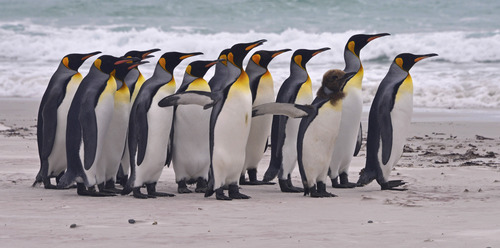
The king penguin, with the scientific name Aptenodytes patagonicus J.F.Miller, 1778, is the second largest penguin species. It is smaller than the emperor penguin but has a somewhat similar appearance. King penguins mainly feed on lanternfish, squid, and krill. During foraging trips, they repeatedly dive to depths of over 100 metres (300 ft), and individuals have been recorded diving deeper than 300 metres (1,000 ft). Predators of the king penguin include giant petrels, skuas, the snowy sheathbill, the leopard seal, and the orca. King penguins breed on subantarctic islands located at the northern reaches of Antarctica, South Georgia, southern Argentina, other temperate islands in the region, Macquarie Island in the Southern Ocean, and the Falkland Islands. In the past, this species was exploited commercially for its blubber, oil, meat, and feathers, but it is fully protected today. King penguins breed on subantarctic islands between 45 and 55°S, at the northern reaches of Antarctica, the Argentinian part of Tierra del Fuego, the Falkland Islands, and other temperate islands of the region. The total king penguin population is estimated to be 2.23 million pairs and is currently increasing. The largest breeding populations are found on the Crozet Islands, which hold around 455,000 pairs, followed by the Prince Edward Islands with 228,000 pairs, the Kerguelen Islands with 240,000–280,000 pairs, and the South Georgia archipelago with over 100,000 pairs. By the early 1920s, the king penguin population in South Georgia and the Falklands was nearly wiped out by whalers working on these islands. Since the Falklands and South Georgia had no trees to use for firewood, whalers burned millions of blubber-rich, oily penguins as fuel, as constant fires were required to boil whale blubber to extract oil. Whalers also used penguin oil for lamps, heating, and cooking, in addition to eating the penguins and their eggs. Macquarie Island currently hosts around 70,000 breeding pairs. The non-breeding range of the king penguin is unknown, though many vagrant individuals have been observed on the Antarctic peninsula, as well as in South Africa, Australia, and New Zealand. One of the largest known king penguin colonies, located on Île aux Cochons in the Crozet Islands, has experienced a massive population drop over the last few decades, falling from around half a million breeding pairs in the 1980s to about 60,000 breeding pairs in 2017. This decline may be caused by ecosystem changes linked to climate change, as the penguins' primary food source has moved farther away from their breeding sites. This factor may also lead to wider population declines and shifts in the location of king penguin breeding grounds. In August 1936, the Nature Protection Society released several king penguins at Gjesvær in Finnmark and Røst in Lofoten in northern Norway. Penguins were seen in the area several times during the 1940s, and there were a small number of unconfirmed sightings in the area during the early 1950s, but no official records of penguins in this area have been made since 1949. In 1971, American zoologist Gerry Kooyman revolutionized the study of penguin foraging behaviour when he published results from his work attaching automatic dive-recording devices to emperor penguins. In 1982, he recorded a dive of 235 metres (771 ft) by a king penguin. The current maximum recorded dive for the species is 343 metres in the Falkland Islands region, and a maximum submerged time of 552 seconds has been recorded at the Crozet Islands. King penguins dive to depths of 100–300 meters (330–980 ft) during daylight hours, spending around five minutes submerged per dive, and dive to less than 30 metres (98 ft) at night. Around 88% of dives undertaken by king penguins, the majority, are flat-bottomed: the penguin dives to a set depth, remains there for a period of time hunting (roughly 50% of total dive time) before returning to the surface. These dives have been described as U-shaped or W-shaped, based on the course of the dive. The remaining 12% of dives follow a V-shaped or "spike" pattern, where the bird dives at an angle through the water column, reaches a set depth, and then returns straight to the surface. Unlike king penguins, other penguin species most often use this latter V-shaped foraging dive pattern. Observations conducted at Crozet Islands found most king penguins stay within 30 km (19 mi) of their colony. Using the species' average swimming speed, Kooyman estimated the average distance travelled to foraging areas is 28 km (17 mi). The average swimming speed of the king penguin is 6.5–10 km/h (4.0–6.2 mph). On shallower dives under 60 m (200 ft), it averages 2 km/h (1.2 mph) while descending and ascending, while on deeper dives over 150 m (490 ft) deep, it averages 5 km/h (3.1 mph) in both directions. King penguins also use a swimming technique called "porpoising", which lets them breathe while maintaining their swimming speed. On land, the king penguin alternates between walking with a wobbling gait and tobogganing—sliding over ice on its belly, propelled by its feet and wing-like flippers. Like all penguins, the king penguin is flightless.