About Aptenodytes forsteri G.R.Gray, 1844
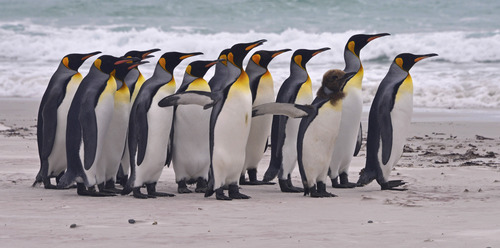
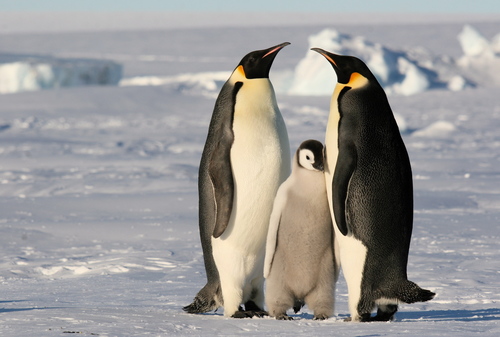
Adult emperor penguins (Aptenodytes forsteri G.R.Gray, 1844) measure 110–120 cm (43–47 in) in body length (measured from bill to tail), with an average of 115 cm (45 in) per Stonehouse (1975). Body length is often confused with standing height, leading to some published height claims as high as 1.5 m (4 ft 11 in), and multiple sources incorrectly list 1.2 m (3 ft 11 in) as standing height rather than body length. While standing height is rarely reported in scientific literature, Prévost (1961) measured a maximum standing height of 1.08 m (3 ft 7 in) from 86 wild individuals. Friedman (1945) found a standing height range of 83–97 cm (33–38 in) from 22 wild individuals. Ksepka et al. (2012) recorded a standing height range of 81–94 cm (32–37 in) from 11 complete specimens held at the American Museum of Natural History. Adult body weight ranges from 22.7 to 45.4 kg (50 to 100 lb), with males weighing more than females. Emperor penguins are the fifth heaviest living bird species, outranked only by larger varieties of ratite. Weight also changes seasonally: both males and females lose a large amount of mass while incubating eggs and raising hatchlings. Males endure extreme Antarctic winter cold for over two months to protect their eggs, eating nothing during this period and losing around 12 kg (26 lb) before eggs hatch. At the start of the breeding season, the average weight is 38 kg (84 lb) for males and 29.5 kg (65 lb) for females. After breeding, both sexes drop to an average weight of 23 kg (51 lb). Like all penguin species, emperor penguins have streamlined bodies to reduce drag during swimming, and their wings are stiff, flat flippers. Their tongues have rear-facing barbs that stop caught prey from escaping. Males and females are similar in size and coloration. Adults have deep black dorsal feathers covering the head, chin, throat, back, dorsal flippers, and tail. This black plumage forms a sharp boundary with the lighter plumage on the rest of the body. The underparts of the wings and belly are white, fading to pale yellow on the upper breast, while the ear patches are bright yellow. The 8 cm (3.1 in) long bill has a black upper mandible, and a lower mandible that can be pink, orange, or lilac. Juveniles have white auricular patches, chin, and throat, with an all-black bill. Newly hatched emperor penguin chicks are typically covered in silver-grey down, with black heads and white facial masks. An all-white plumage chick was documented in 2001, but it was not classified as albino because it did not have pink eyes. Chicks weigh about 315 g (11.1 oz) when they hatch, and fledge once they reach roughly 50% of adult body weight. Emperor penguin dark plumage fades to brown between November and February, which is Antarctic summer, before the annual moult that occurs in January and February. Moult happens much faster in this species than in most other birds, completing in approximately 34 days. Emperor penguin feathers begin emerging from the skin once they have grown to one-third of their full total length, before old feathers are shed. This pattern helps reduce heat loss. New feathers push out old feathers before finishing their own growth. The average yearly survival rate for adult emperor penguins is measured at 95.1%, with an average life expectancy of 19.9 years. Researchers estimate that 1% of hatched emperor penguins can live to 50 years of age. Only 19% of chicks survive their first year of life, and as a result, 80% of the total emperor penguin population is made up of adults aged five years or older. Emperor penguins have a circumpolar distribution in the Antarctic, found almost exclusively between 66° and 77° south latitude. They almost always breed on stable pack ice near the coast, up to 18 km (11 mi) offshore. Breeding colonies are typically located in areas where ice cliffs and icebergs shelter them from wind. Three land-based breeding colonies have been recorded: one (now gone) on a shingle spit at the Dion Islands on the Antarctic Peninsula, one on a headland at Taylor Glacier in Victoria Land, and one most recently reported at Amundsen Bay. Since 2009, a number of colonies have been reported living on shelf ice instead of sea ice, and some colonies move to shelf ice in years when sea ice forms late. The northernmost breeding population is located on Snow Hill Island, near the northern tip of the Antarctic Peninsula. Individual vagrant emperor penguins have been observed on Heard Island, South Georgia, and occasionally in New Zealand. The northernmost vagrant ever recorded was observed in Denmark, Western Australia in November 2024. This individual, thought to have come from eastern Antarctica, was found by a group of surfers shortly after it arrived, and was taken in by conservationists with the Department of Biodiversity, Conservation and Attractions to have its health assessed. In 2009, the total global emperor penguin population was estimated at around 595,000 adult birds, across 46 known colonies distributed around the Antarctic and sub-Antarctic. Roughly 35% of the known population lives north of the Antarctic Circle. Major breeding colonies are located at Cape Washington, Coulman Island in Victoria Land, Halley Bay, Cape Colbeck, and Dibble Glacier. Colonies change in size and location over time. They often split into smaller separate "suburbs" that move away from the original parent colony, and some entire colonies have been recorded disappearing. The Cape Crozier colony in the Ross Sea shrank dramatically between the Discovery Expedition's first visit in 1902–1903 and the Terra Nova Expedition's later visit in 1910–1911, dropping to just a few hundred birds and possibly nearing extinction due to shifts in the ice shelf's position. By the 1960s the colony had rebounded strongly, but by 2009 it had again declined to a small population of around 300 birds.