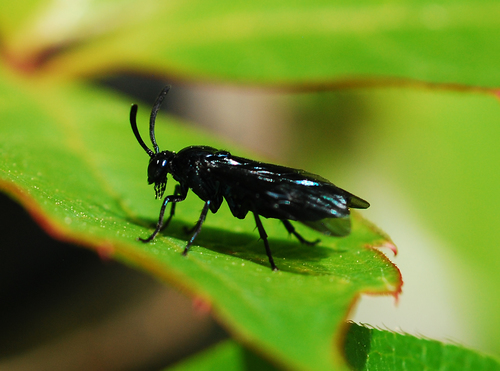
About Aproceros leucopoda Takeuchi, 1939
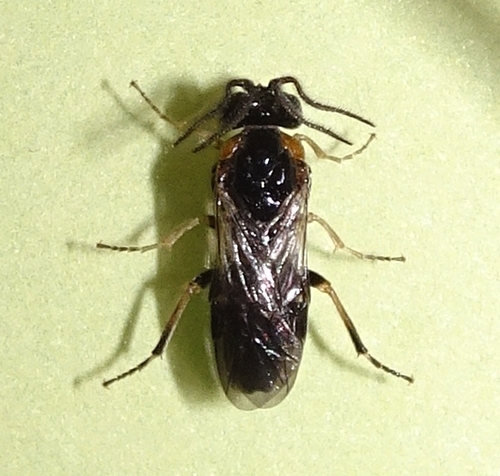
Aproceros leucopoda, commonly known as the elm zigzag sawfly, is a sawfly species belonging to the family Argidae. It is native to eastern Asia, specifically occurring in China and Japan. It has been an invasive species in Europe since 2003, and in North America since 2020. Elm zigzag sawfly larvae are green. Newly hatched larvae measure around 4 mm long, and reach a full grown length of 10 mm. Larvae feed exclusively on leaves of elm trees (genus Ulmus). Young larvae create a very distinct zigzag-shaped cut pattern in elm leaves, which gives the species its common English name. As larvae develop through 4 to 7 instars, their feeding traces become less regular, and are harder to distinguish from feeding damage caused by other insects that feed on elm leaves. Larvae finish growing within 2 to 3 weeks, after which they spin a transparent, lattice-like cocoon on the underside of an elm leaf, where they pupate. The pupa is also green, and measures around 8 mm long. Adults emerge 4 to 7 days after pupation. Adults are small black sawflies that are 6 to 10 mm long, with pale colored legs. This species has several generations per year. The final generation produced each autumn creates a thicker, more solid cocoon, which drops from the tree along with falling autumn leaves. The species overwinters as a pupa in leaf litter, and adults emerge the following spring. As an invasive species, it was first recorded in Europe in 2003, with initial observations in Poland and Hungary. It spread westward from this initial area, reaching southeastern England in 2017. The first record of the species in North America comes from Quebec in 2020, and it has since spread to multiple U.S. states. Infestations can cause severe defoliation of elm trees, which can lead to the decline and death of affected trees, especially when the defoliation weakens trees and allows other diseases to attack them.