About Aprasia striolata Lütken, 1863
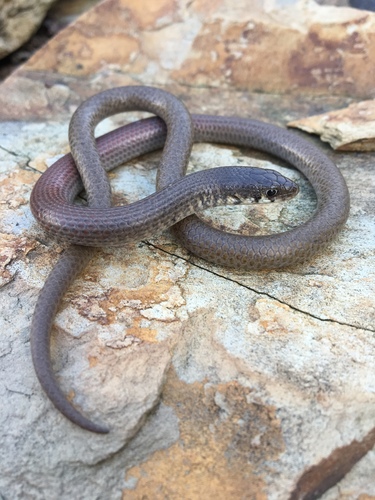
Aprasia striolata Lütken, 1863 is a member of Pygopodidae, a family of legless lizards. This family is defined by extremely elongated bodies, and either reduced limbs or no limbs at all, which gives members a snake-like appearance. The Aprasia genus is morphologically diverse, and all its species are small, worm-like burrowers. Several morphological and feeding features make this genus similar to sympatric blind snakes of the family Typhlopidae. This species has two known isolated populations: one located in the south-west of Western Australia, and another that stretches from western Victoria to the Eyre Peninsula in South Australia. Aprasia striolata is a burrowing species found in a wide range of habitats that mostly contain dry sandy or loamy soils. Both male and female Aprasia striolata appear capable of reproducing year round. Gravid females and males with enlarged testes have been collected in every season, which differs from the reproductive pattern of all other squamate species found in this relatively cool-climate region of southern Australia, which all have strongly seasonal reproductive cycles. This year-round reproductive activity suggests female A. striolata are likely able to produce more than one clutch of eggs per year. The observation that males have enlarged testes through most of the year could mean either that mating occurs year round, or that testes enlarge during autumn and winter before mating takes place in spring. This species is oviparous, and produces thick-shelled, elongated eggs. For the Aprasia genus as a whole, males have premaxilla teeth, while juveniles and females lack these teeth. Evolutionary biologists have generally interpreted this difference in two ways: either it is a product of sexual selection, improving a male's ability to win physical fights against other males or to hold females during copulation, or it is tied to diet, allowing males to eat different or larger prey than females. Because there is no evidence of dietary differences between male and female Aprasia striolata, current research suggests sexual selection is the cause of this species' sex-based dentition difference.