About Appias libythea (Fabricius, 1775)
Scientific name: Appias libythea (Fabricius, 1775)
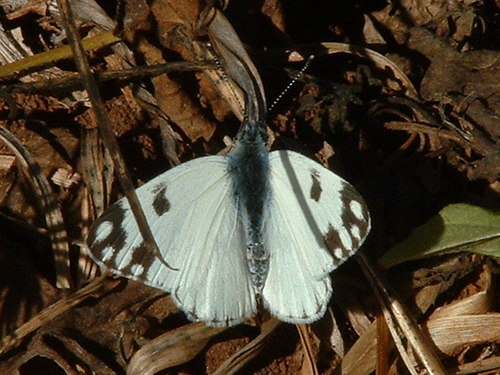
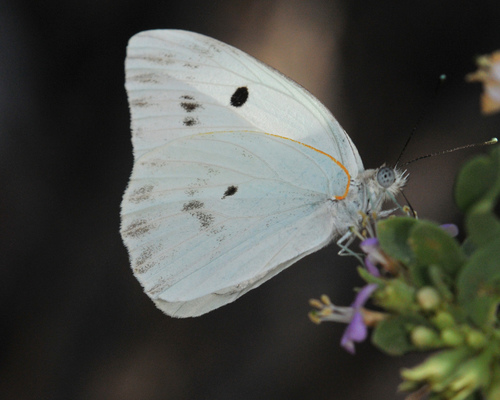
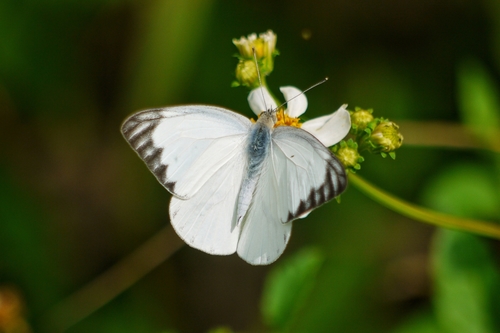
Wet-season brood: Male. Upperside is greyish-white. The forewing has a black costal edge, and a basal costal border covered in grey-black, dust-like scales; there is also a very narrow, toothed outer marginal band covered in black scales that narrows as it extends from the subcostal area to the submedian area. The hindwing has very small, indistinct blackish-scaled marginal points at the veins, which are not visible on some specimens that likely emerged near the start of the dry season. Underside is white. The forewing has slightly blackish costal and outer edges; a few greyish-black scales are present along the base of the costa. The hindwing has no markings.
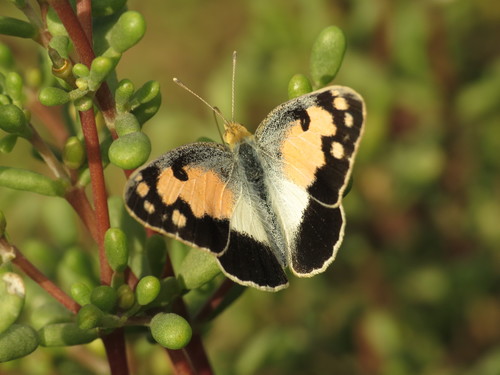
Female. Upperside is greyish-white. The forewing has a greyish-black costal edge, and a broad longitudinal band that starts at the base of the costa, fills the cell, and leaves only a thin streak clear above the median vein. This black cell-band extends thinly along the upper median veinlet to join a broad, decreasing outer-marginal band that curves in a sinuous path from before the apex to the posterior angle. This outer-marginal band encloses a white, oblique, square-shaped sub-apical patch, and shows faint paler streaks between the veins. In extreme wet-season specimens, a less intense pointed greyish-black fascia extends outward from below the cell to the disc. The hindwing has a greyish-black marginal band made of large merged spots, or of more slightly separated spots that fade diffusely toward the anal angle. This band is connected by similarly colored scales along the veins, from the lower subcostal area to a curved paler discal fascia that is not visible toward the posterior section of the wing. Underside is white. Both wings have dark-grey markings arranged in the same pattern as the upperside. On the forewing, the outer band is crossed by evenly spaced white streaks; in some individuals, the band itself is white, with only its inner edge outlined in dark grey. On the hindwing, the outer marginal spot-based band is indistinct or no longer visible; the base of the costa is pale yellow. Some intermediate female specimens, which match the original Fabrician type specimens of libythea and likely emerged near the dry season, show variation on the upperside. On the forewing, the connecting black streak along the upper median vein to the outer band, and the lower basal fascia, are either partially or fully not visible. On the hindwing, the marginal spots are smaller and more or less well separated, and the discal fascia and its connecting vein markings are also not visible or most often completely absent. On the underside, markings are much less defined. On the forewing, the outer band is very faintly marked only by its greyish inner edge, and the apical area is entirely white or has a very faint pale yellow tint. On the hindwing, the base ground color is either white or has a very faint pale yellow tint, the discal fascia is only faintly visible, and marginal spots are entirely absent.
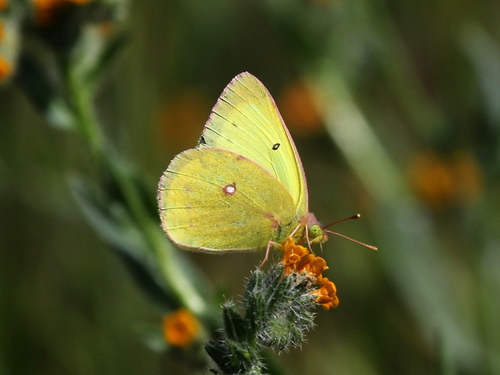
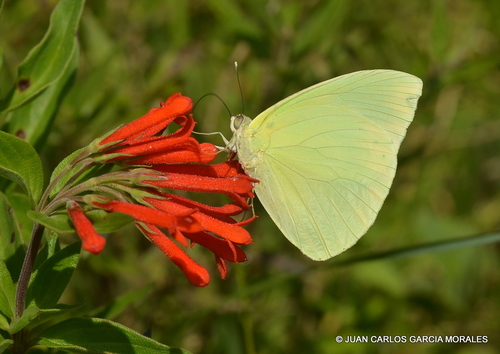
Dry-season brood: Male. Upperside: The forewing has a broader, diffused outer-marginal band covered in grey-black scales. The hindwing has no markings. On the underside, the apical area of the forewing and the entire hindwing are tinted very pale yellow.
Female. Upperside: On the forewing, the cell-band and marginal band are somewhat narrower than in intermediate form specimens, and the connecting streak is completely absent. The hindwing has no markings. On the underside, the cell-band and marginal band of the forewing are faintly visible, and the apical area is tinted pale yellow. The entire hindwing is tinted pale yellow; the discal fascia is faintly visible.