About Appias lalage (Doubleday, 1842)
This description covers Appias lalage (Doubleday, 1842) across three seasonal forms: wet-season, intermediate, and dry-season broods.
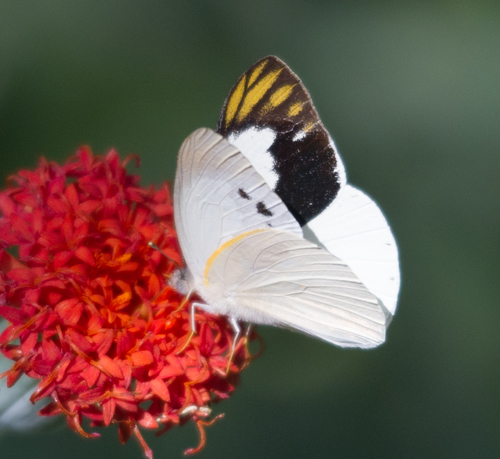
Wet-season brood, male: Upperside is greyish-white, with a glossy basal area on the fore wing. The base of the fore wing's costal border is thickly dusted with grey-black scales; these scales are also scattered along the upper area of the cell, reaching the black discocellular spot. From the spot, black color extends along the costa into a broad outer marginal band that narrows toward the wing edge and ends abruptly at the lower median vein. In some specimens, black scales scatter obliquely inward toward the posterior margin, enclosing a white spot at the wing angle similar to the spot found in females. The anterior inner edge of the band curves sinuously outward from the costal border above the cell end to the upper median vein; below the upper median, it extends inward in a square shape then turns outward to the lower median. The band encloses two small, obliquely arranged white sub-apical spots, sometimes an additional faint upper spot, and a large angular spot between the upper and middle median veins. A more or less large black spot also sits on the lower discocellular veinlet, and this spot is generally joined either slenderly or broadly to the outer band along the upper median veinlet. The hindwing has a narrow, almost spot-like black outer-marginal band, and usually has a connected zigzag submarginal series of blackish scales that extends inward from the lower sub-costal vein to the upper median. In some specimens, these scales are faintly and broadly scattered across the posterior area from this point. On the underside, the forewing is greyish-white, with the same black discocellular spot and outer marginal band seen on the upperside; the band is narrower toward the front of the wing, and the apical area is ochreous-yellow. Distinctly visible blackish scales generally extend inward from the lower end of the band toward the posterior margin. The hindwing is uniformly ochreous-yellow, with faintly visible slender zigzag submarginal fascia made of blackish scales and a similar, less visible medial fascia; there is a distinct black dot on the discocellular veinlet.
Wet-season brood, female: Upperside is greyish-white. On the forewing, the base of the costa and the basal two-thirds of the cell are covered in dark grey-black scales. The black outer border is broader than in the male, extending rearward to the posterior angle, then decreasingly inward along the margin to the wing base. Its projecting portion between the upper and middle median extends broadly obliquely inward, covering the discocellular spot and crossing the anterior half of the cell. This leaves only a narrow, outwardly oblique, recurved upper white band and a broad lower white band; the basal portion of the lower white band is sometimes glossy. The extreme edge of the wing's posterior margin and its cilia are also white. The sub-costal spots and medial white spot match those on the male upperside, though the medial spot is smaller, and there is an additional white spot at the posterior angle. The hindwing is greyish-white, and its basal area sometimes has a very faint pale yellow tint. It has a prominent black outer-marginal band and connected zigzag submarginal fascia, which becomes broadly continuous and more or less confluent across the posterior area. On the underside, the forewing has duller black markings matching the upperside, except the apex is broadly pale greyish ochreous-yellow or glossy grey, with only faintly indicated sub-apical spots; the base of the cell and the costa are pale yellow. The hindwing is paler yellow than in the male, or greyish-white and slightly glossy. The yellow is most clearly defined along the vein borders and extreme outer margin. It has faintly visible dusky-scaled submarginal and medial zigzag fascia, and a black discocellular dot, just like the male; the outer marginal interspaces are whitish and somewhat glossy.
The body of both sexes is greyish-white; the front of the head and the upper side of the abdomen are dark grey. Antennae are black on the upper side, and white on the underside in males. Anal tufts are blackish, and the intromittent organ is sometimes extended.
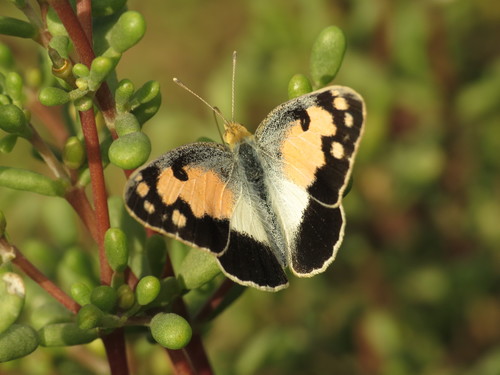
Intermediate form, male: On the upperside forewing, the black outer band is somewhat narrower, the projecting discal portion and the discocellular spot are generally smaller, and the discocellular spot is usually isolated. Three sub-apical white spots are sometimes present, and the white spot in the median interspace is larger. The hindwing has a narrower, spot-like black outer-marginal band, or its spots are only slenderly defined at the vein ends. On the underside, the forewing matches the upperside, and the apex is paler yellow than in the wet-season form. The hindwing matches the wet-season form, but is generally paler yellow.
Intermediate form, female: On the upperside, the forewing matches the wet-season form, except the black outer band is less intensely black below the lower median and extends inward only faintly to about halfway along the posterior margin. The hindwing's black outer-marginal band is less intense than in the wet-season form, more spot-like, and its connected zigzag submarginal fascia is less defined, becoming faint posteriorly from the upper median. The underside matches the wet-season form. On the forewing, the outer band is less defined posteriorly from the lower median. The hindwing is pale yellow, with whitish marginal interspaces that are not glossy.
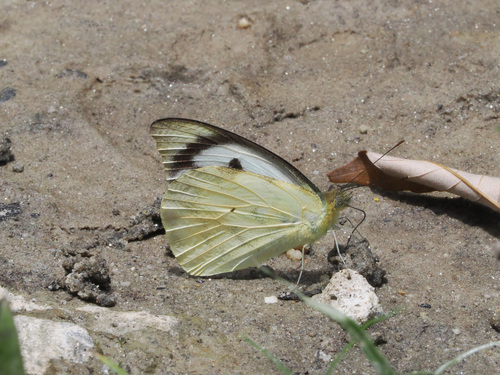
Dry season form, male: Individuals are smaller than the wet-season form. On the upperside forewing, the base is glossy. The black outer band is somewhat narrower, its discal portion is more or less disconnected, and its posterior end always terminates at the lower median. The discocellular spot is smaller and always isolated. The hindwing is either entirely white, or only has a thin black line at the tip of the upper veins. On the underside, the black outer band on the forewing is less prominent than in the wet-season form, it is also narrower and broken along its length. The apical area is pale greyish-ochreous and lightly dusted with brown scales, and the discocellular spot is isolated. The hindwing is pale brownish-ochreous, lightly dusted with brown scales. The submarginal and discal zigzag brownish-scaled fascia are faintly defined, and the black discocellular dot is distinct.
Dry season form, female: Individuals are smaller than the wet-season form. On the upperside forewing, the base is glossy. The black outer band is similar to that of the wet-season form; its lower end terminates either at the lower median, or has scattered scales extending inward before the posterior angle. The discocellular spot either extends slightly along the upper median, or is broadly joined to the discal portion of the outer band and extends inward along the upper area of the cell. On the hindwing, the black outer marginal band is spot-like and grows increasingly faint toward the rear, or the band is more continuous with a faintly visible zigzag submarginal fascia of blackish scales. On the underside, the forewing has black markings matching those on the upperside. The apical area is greyish-ochreous and dusted with brown scales, and the base of the cell is tinted greyish-ochreous. The hindwing is pale greyish-ochreous and heavily dusted with brown scales, except for the outer-marginal interspaces where these scales are less visible. The darker-scaled discal and submarginal zigzag fascia and the black discocellular dot are distinct.