About Appias indra (Moore, 1858)
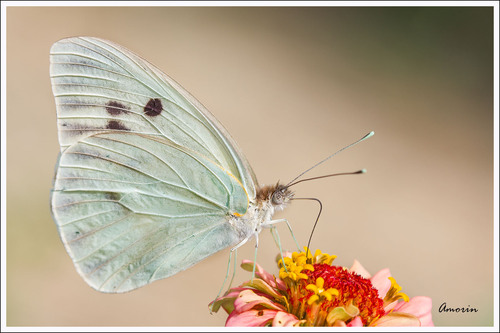
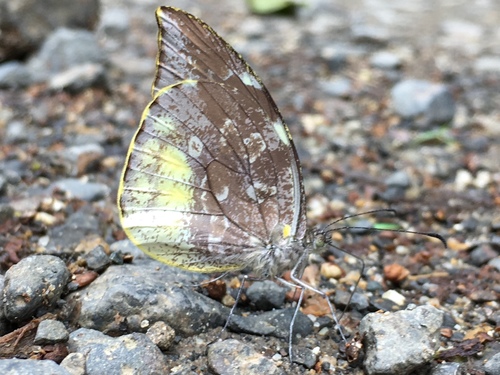
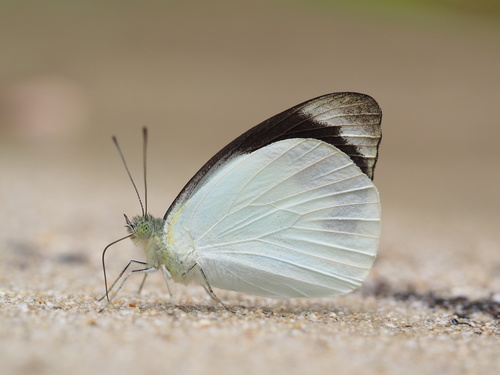
This description covers Appias indra, originally described by Moore in 1858, with separate accounts for wet-season and dry-season broods. For the wet-season brood: Males have greyish-white upper sides. On the fore-wing, the base of the costal border is covered in grey-black scales that merge into a broad black band along the apical outer margin. This band narrows as it goes, terminating narrowly at the lower median veinlet. It curves outward from the costal border to the upper median, then extends inward in a roughly quadrate shape in the next interspace, before extending outward narrowly again to the lower median. Three or four white spots sit before the apex; the uppermost and lowermost spots are the smallest. A minute black dot is usually present on the lower discocellular veinlet. On the hind-wing, a small number of black scales are thinly spread along the anterior outer margin and on the vein tips, and a minute dot sits on the upper end of the discocellular veinlet. On the underside, the fore-wing is greyish-white. The outer black band is narrow and restricted to the subapical region, the apical area is pale yellow, the upper-side spots are faintly visible, and the black discocellular dot is also visible. The hind-wing is pale yellow, with more or less faintly defined brown-scaled zigzag discal and submarginal fasciae, and a distinct black discocellular dot. For wet-season brood females, the upper side is fuliginous-black. The fore-wing has a central longitudinal greyish-white patch, with a sinuous outer edge and dark grey scaled basal area; it also has two small oblique sub-apical white spots, and white posterior cilia. The hind-wing has greyish fuliginous-brown basal and discal areas, with veins lined in greyish-white. The cell and abdominal area are covered in long fine grey hairs, it has two small upper submarginal greyish-white spots, and white cilia. On the underside, the fore-wing has a black outer border shaped the same as on the upper side, an ochreous-yellow apex, and less defined white spots; the discal area is greyish-white, with the base suffused with sulphur-yellow. The hind-wing is ochreous-yellow, very sparsely dusted with minute brown scales, crossed irregularly by brown-scaled zigzag discal and submarginal fasciae, and has white outer marginal interspaces, plus a brown discocellular dot. For the dry-season brood: Males are somewhat smaller than the wet-season form, and have a similar upper side pattern to wet-season males. On the fore-wing, the black outer band is narrower and less prominent, usually ending above the lower median veinlet, and the white spots enclosed within the band are generally larger, usually numbering five. The hind-wing has no markings. On the underside, the outer black band on the fore-wing is narrower than in the wet-season form, and is obsolescent posteriorly or entirely absent, with its position only marked by a few dark scales; the apex is pale yellowish-white speckled with brownish scales. The hind-wing is pale yellowish-white, more or less speckled with minute brown scales and crossed by a zigzag discal and submarginal fascia, though in some specimens these brown scales and fasciae are almost obsolete; the black discocellular dot is always present. For dry-season brood females, on the upper side the fore-wing has a broader greyish-white area and a less black-scaled posterior border than the wet-season form. The hind-wing has greyish-white basal and discal areas, with the outer black border enclosing a submarginal row of large, irregularly shaped whitish spots. The underside is similar to the wet-season form: the fore-wing has a somewhat narrower black outer band and a white spot at the posterior angle, and the hind-wing has more numerous brown scales. The recorded food plants for this species are Drypetes oblongifolia and Putranjiva roxburghii, both belonging to the plant family Putranjivaceae.