About Aporosa octandra (Buch.-Ham. ex D.Don) Vickery
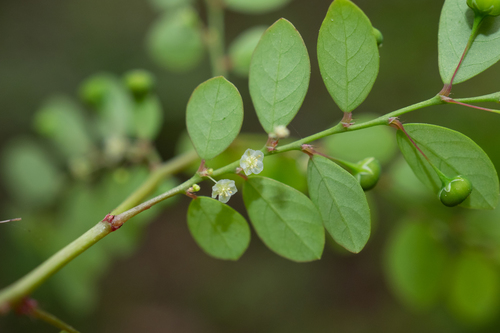
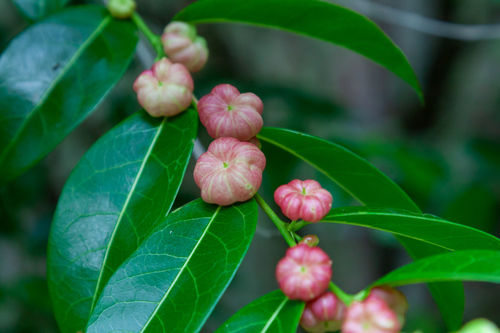
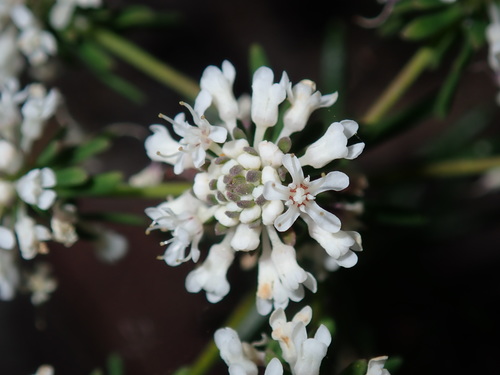
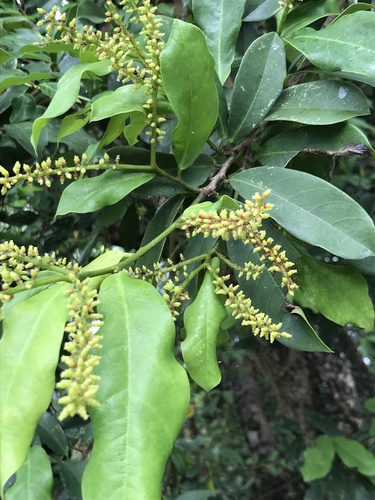
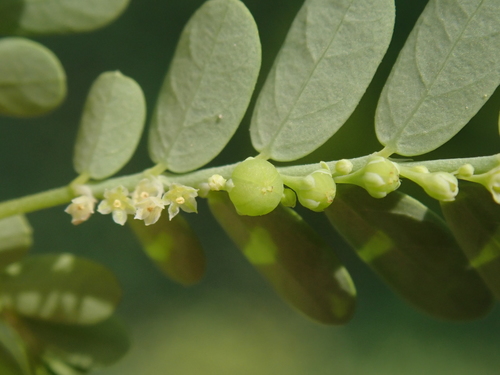
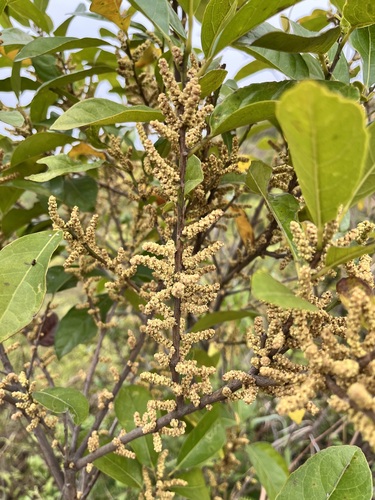
Aporosa octandra (Buch.-Ham. ex D.Don) Vickery is most often a tree, sometimes a shrub, that can grow up to 15m tall with a trunk diameter of up to 30 cm. In India, individuals usually grow 9-12m tall and are often shrubby. The outer bark ranges in colour from light-brown to grey or tan, and its texture can be smooth, roughened, thickened, flaky, or marked with narrow vertical ridges and cracks. The inner bark is pink, and the wood is cream-coloured. Branchlets typically bear a few small scars from fallen leaves. The leaves are narrow, ranging from ovate to elliptic in shape, and measure 5-23.5 by 2-8 cm. The leaf base is rounded to cuneate or obtuse, leaf margins are weakly undulate to weakly glandular-crenate or serrate, and are sometimes slightly recurved. The leaf apex is acuminate to cuspidate. Leaves are thin, smooth, not brittle, and have a dull or slightly shiny surface; when dried, leaves are grey-brown to green-brown on the upper surface and greenish to brownish on the lower surface. Inflorescences grow axillary or just below leaves. Staminate inflorescences grow in clusters of 1 to 5, holding 6 to 8 loosely arranged flowers; staminate flowers have 4 sepals and two stamens. Pistillate inflorescences grow in clusters of 1 to 3, with up to 11 densely arranged flowers along the rachis. Pistillate flowers have 4 sepals, occasional staminodes, and slightly raised elongated stigmas that are perpendicular to the sides of the ovary. Fruits are ovoid to ellipsoid, rarely globose. Young fruits are slightly stipitate and beaked, measure 9-13 x 6-10mm, are punctate, and dry to dark brown or black with sparse hairs. Each fruit contains 1, rarely 2, terete ellipsoid seeds that measure 7-8 x 5-6 x 3-4mm. Like other species in the Appendiculatae section of the Aporosa genus, this species has basal and adaxial glands, disc-like glands scattered unevenly within arches of marginal veins across the abaxial surface of the leaf lamina, papillate stigmas, and an ovary with pubescent septae and column. Varieties are described below, with the caveat noted by Schot. The species is native across a range from Queensland, Australia and New Guinea, through Southeast Asia, to southern China and India. Specific native countries and regions include: Australia (Queensland); Papua New Guinea; Indonesia (West Papua, Sulawesi, Kalimantan, Java, Sumatra); Philippines; Malaysia (Sabah, Sarawak, Peninsular Malaysia); Thailand; Cambodia; Vietnam; China (Hainan, South-Central, Southeast); Laos; Myanmar; India (Nicobar Islands, Andaman Islands, Assam, Nagaland, Manipur, Mizoram, Tripura, Meghalaya, Sikkim, West Bengal, Odisha, Uttarakhand); Bangladesh; East and West Himalaya; Bhutan; Nepal. A. octandra var. chinensis is native from Southeast China (including Hainan) to northern Vietnam. A. octandra var. malesiana is native from parts of Malesia to southwestern Thailand, with recorded native regions including the Philippines; Indonesia (Sulawesi, Kalimantan, Sumatra, Java); Malaysia (Sabah, Sarawak, Peninsular Malaysia); and southwestern Thailand. Records of this variety from New Guinea and Queensland are noted as erroneous. The autonym variety A. octandra var. octandra is native from Southeast Asia to South Central China and the Himalayas, with recorded occurrence in Thailand; Cambodia; Vietnam; China (Guangdong, Guangxi, Hainan); Laos; Myanmar; India (Nicobar Islands, Andaman Islands, Assam, and other areas); Bangladesh; the East and West Himalaya region; and Nepal. A. octandra var. yunnanensis is native from parts of Southeast Asia to Yunnan, China, with recorded growth in Thailand; Cambodia; Myanmar; Laos; and Yunnan (China). The species grows in a wide variety of habitats, including primary forest, secondary forest, subtropical forest, evergreen forest, (mixed) deciduous forest, savannah, and belukar (low forest or scrub, possibly anthropogenic), in conditions from moist to rather dry. It favours shaded understorey or partly to fully open locations (with additional notes for Hong Kong below). It tends to be a gallery species, favouring hills, steep slopes, forest edges, roadsides, plains, thickets, and areas alongside watercourses. It grows in a wide range of soil types, including sandy soil, sandstone-derived soil, granitic sand, limestone-derived soil, clay, and rocky to rocky loam, on bedrock of granite or sandstone. It occurs at altitudes ranging from 40m to 1500m, and generally flowers and fruits year-round. In Na Haeo Forest Reserve, Na Haeo District, Loei Province, northeastern Thailand, A. octandra var. yunnanensis is locally dominant in bamboo-deciduous forest, growing alongside Cananga brandisiana, Croton persimilis, Gardenia sootepensis, Lagerstroemia sp., Colona flagrocarpa, and Pterocarpus macrocarpus. In the medium forest layer (around 6-9m tall), varieties octandra and yunnanensis are common, growing alongside Quercus kerrii, Memecylon scutellatum, Harrisonia perforata, with a dense bamboo understory. Bamboo cover is so high that bamboo control measures have been suggested to increase woody tree species richness and diversity. In a reforestation project in the Doi Tung mountainous area of northern Thailand, two varieties of A. octandra grow in the area. Both grow as deciduous trees at this location, flower in January and February, and fruit in May and June. The octandra variety grows in both evergreen forest with bamboo and disturbed areas including roadsides, grows on soils derived from granite and limestone bedrock, occurs between 1200 and 1375m altitude, and holds leaves from May until December. The yunnanensis variety grows in evergreen forest, in soils derived from granite bedrock, at elevations of 1100 to 1450m, and holds leaves from April to December. On the islands of the Mekong river in Kratié and Steung Treng Provinces, northern Cambodia, the yunnanensis variety is moderately common in dipterous deciduous forest, and also occurs in degraded areas and secondary growth communities. In this area, it is deciduous, grows on sediments derived from metamorphic sandstone bedrock, at around 25 to 30m above sea level. In India, it is commonly found in primary forests and grasslands, growing on sandy, clay or rocky soil, at up to 1200 m altitude. Mizoram University in India is located within a regenerating tropical wet evergreen and semi-evergreen forest, where the dominant trees are Schima wallichii, Aporosa octandra, Castanopsis tribuloides, and Syzgium praecox. The now-regenerating forests of Hong Kong were heavily degraded in the 19th and early 20th centuries, with the most severe impact occurring during World War II (1941-1945 here). In Hong Kong, A. octandra is not only a light-demanding early pioneer of rainforest, it is also an indicator species, alongside Garcinia oblongifolia, of early pioneer communities that tend to disappear as more mature vegetation communities become established. This dynamic leads to pioneer communities having higher diversity than more established vegetation. In China, the octandra variety grows in montane sparse forests or scrub. The whitefly species Cockerelliella setosus, from Little Andaman Island, India, infests A. octandra. Hanuman langurs (Semnopithecus entellus) in Nepal's subtropical forests eat the young leafy parts and inflorescences of A. octandra, but do not eat the fruits, so they do not play any role in the plant's seed dispersal. Three insect species have been recorded forming galls on the leaves or twigs of this species: Dolcrothrips tryboni, Acerocecidium sp., and Eriophyes aporosae. The tree or shrub provides fodder for domesticated animals, timber for house construction (particularly for house posts), and wood for fuel. The bark produces a red dye, and a decoction of the leaves is used to dye clothes black in northeast India. The fruits are edible. In India, the bark is chewed as a type of betel. The wood, called kokra or coco wood, is described as durable, hard, and close-grained, and is used in construction for house posts, rafters, rice pounders, and furniture. The Karbi people of Karbi Anglong district, Assam, India, use the twigs and leaves of the plant (which they call tamsir) as a mordant when dyeing yarn black with black minerals. The leaves are also used to keep yarn from contacting the dyeing vessel, which is believed to prevent the yarn from becoming brittle. This same leaf use occurs when dyeing yarn pink using dye from the lac insect Kerria lacca. The species has many recorded uses in traditional medicine across Asia, including in historical Ayurvedic medical practices. In Cambodia, bark is an ingredient in a folk remedy to relieve toothache, while roots are used in another folk medicine mixture used "against women diseases after delivery". In Mizoram, it is recorded as a treatment for many ailments. A. octandra var. malesiana has hard wood used for house planks, beams, and furniture.