About Aporophyla australis Boisduval, 1829
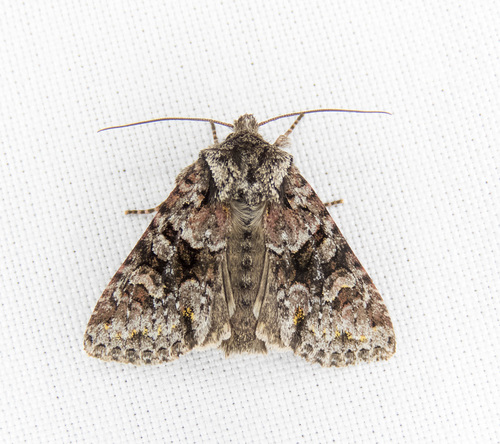
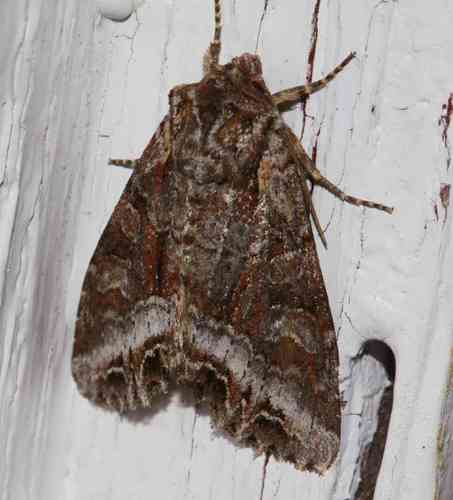
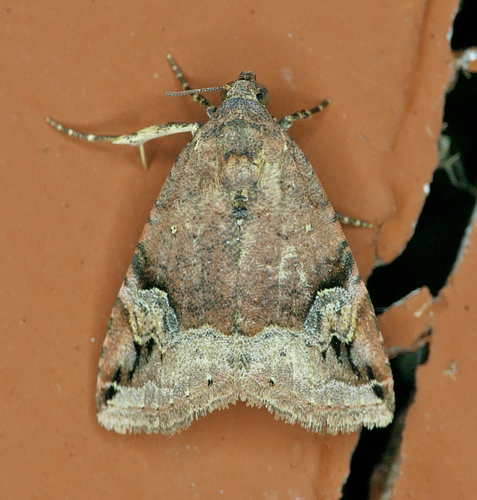
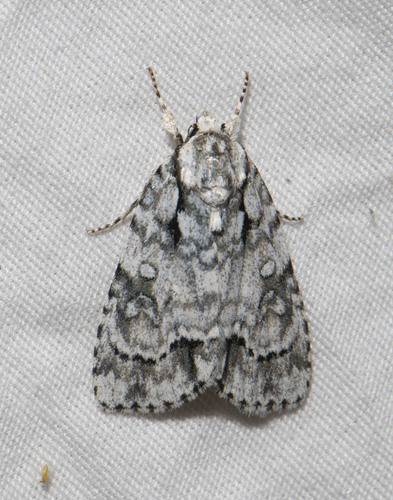
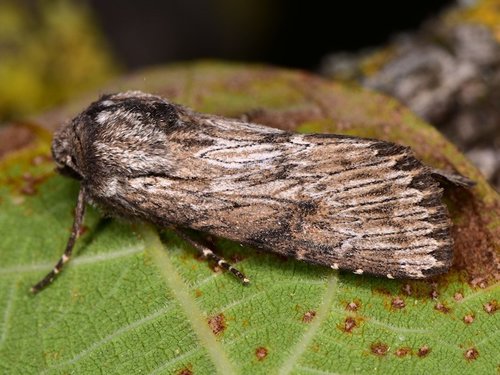
Aporophyla australis, first described by Boisduval in 1829, has a wingspan of 36–42 mm. Its forewings are whitish grey with a faint lilac tint; darker veins, narrow dark edging along the costa and inner margin, a median shade between the stigmata, wedge-shaped subterminal blotches in the interspaces before the subterminal line, and dark chequering of the fringe are all brown. Both the inner and outer lines are strongly dentate, but are rarely distinct except as streaks along the inner margin. The stigmata are finely outlined with black: the orbicular stigma is narrow and oblique, and the reniform stigma is broader. When clear, both stigmata have a dark center. The streak from the base along the submedian fold is brown and indistinct, and a brown shade is often visible on the submedian fold between the claviform stigma and the outer line. The hindwing is white in males, and slightly flushed with brown in females. The type form was originally recorded from Provence and Corsica. There are multiple recognized forms and aberrations. A. australis ab. costata ab. nov. (Warren) is a larger form, where the brown tints of the type form are replaced by blackish fuscous, with particularly strong darkening of the forewing costal area and fringe; the lines remain equally indistinct. This aberration has been recorded from Rome, an unconfirmed female from Germany, and a single male from Amasia. A. australis scriptura Frr. is uniform dark grey, with clear, distinct dentate inner and outer lines. A. australis scriptura form ingenua Frr. is an extreme dark variant, where markings are sometimes entirely obscured by dark suffusion; these variants come from Greece, Turkey, and Asia Minor. A. australis cinerea Stgr., from Morocco, is described as having unicolorous grey forewings. A. australis pascuea, the British form, is most similar to the type form but is whiter. In male pascuea all markings are very strongly developed and black, while female pascuea are pinkish grey. The orbicular stigma varies widely in this form, from a small round mark to a long elliptical mark that becomes confluent with the reniform stigma. The larva is yellowish green, with a reddish tinge on the upper side. A pale reddish line running along the middle of the back bears black V-shaped marks, and a series of black marks runs along each side of the body. The line along the spiracles is yellowish. The head is green, freckled with brown. In the British Isles, adults fly from August to October in one generation per year. In the Balkans, there are two generations per year, with a flight period from August to December. Larvae feed on a variety of plants, including Silene maritima and grasses. Larvae can be found from October to May. This species overwinters in the larval stage, and pupation occurs under moss or underground.