About Aporia crataegi (Linnaeus, 1758)
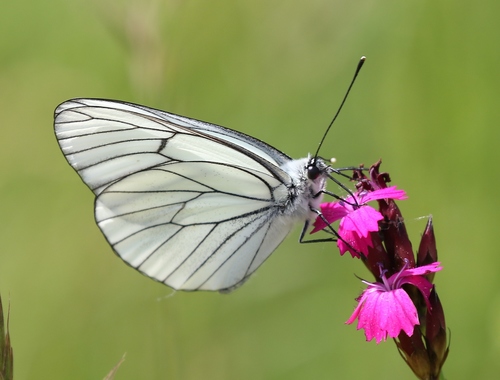
The black-veined white, Aporia crataegi (Linnaeus, 1758), has a wingspan of 51 to 70 mm (2.0 to 2.8 in), with females typically larger than males. The upper side of both its forewings and hindwings is translucent white, boldly marked with black veins. In males, the underside of the wings matches this appearance, while females have brown veining on the underside. Females also lose most of their wing scales from rubbing their wings together, which leaves their wings almost completely transparent. This butterfly can be distinguished from other white butterflies in the genus Pieris by its distinctive patterned veined wings. Freshly laid eggs are yellow, and darken as they mature. Caterpillars are greenish grey with transverse banding. The pupa is creamy white with black markings, and is attached to a twig by a silken girdle. Seitz's description of A. crataegi L. (17 a) notes the species is white with thin black veins; females have a large sparsely scaled discal area on the forewing, and the underside matches the upperside. Its range covers all of Europe and North Asia, extending far north and reaching south into North Africa to the slopes of the Aures Mountains; it is not present in Egypt. The aberration ab. alepica Cosmorici (17 a) has completely transparent wings across all four wings. The form augusta Tur. (19 a), found in Sicily, has more distinct black cross-veins, nervules more heavily dusted with black along the distal margin, and all veins more broadly edged with black on the underside. The subspecies hyalina subsp. nov., from the Taurus Mountains of southern Asia Minor, has males that are pure white with thin dark veins, and the vein tips are barely noticeably darkened. Females of this subspecies are not quite as transparent as alepica, with faint but broad dark edges to the distal veins, and more densely black shaded cross-veins on the forewing. The subspecies pellucida subsp. nov., from Aidere, has sparse scaling in both sexes, with dark vein streaks extending farther toward the wing base. On the underside, the hindwing and the apex of the forewing have a yellowish tint, and the forewing veins are rather broadly edged with fuscous. Tutt also lists the following additional aberrations: suffusa specimens have fuscous shading; marginata individuals have a distinct black distal marginal band on the hindwing, somewhat resembling the pattern of Colias edusa; lunulata has broadly marked black disco-cellulars on the hindwing that form a distinct black half-moon shape; melana has fuscous stripes between the veins on the underside of the hindwing; flava refers to entirely yellow specimens. Mature larvae are covered in short whitish hairs, are ashy grey with a black dorsal region, and have two orange-yellow or brown-red stripes along the back plus a reddish-yellow line above the legs. The head, thoracic legs, and anal legs are black. Larvae feed on Prunus, Pirus, and Crataegus, and reach adulthood in May. The pupa is whitish with dots merged to form star shapes. The egg is conical and yellowish. This butterfly is still locally common, though its population numbers and range have decreased considerably due to the systematic destruction of its winter nests and removal of blackthorn hedges. Historical records note large swarms and migratory flocks of this butterfly. The historical phenomenon called the "oracle of the blood-rain" is attributed to the dark red excretions produced by large numbers of these butterflies that emerged from pupae in a small area. The species is most common in Central Europe. Dr. Seitz found the species occurring more singly in East Asia and also in Algiers, where he encountered it near Lambeze in June. A. crataegi is rarer in southern Japan than in northern Japan, and this also holds true for Amurland, where it flies alongside A. hippia. This species occurs in open forest, grazing land, orchards, lanes, gardens, meadows, and thickets throughout most of Europe, temperate Asia, Korea, and Japan. It has been completely extirpated from the British Isles, though unofficial reintroduction attempts have been made in southern England.