About Apophyllum anomalum F.Muell.
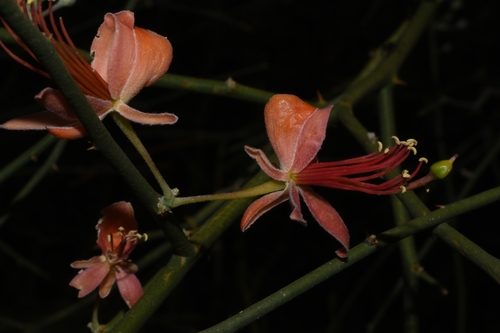
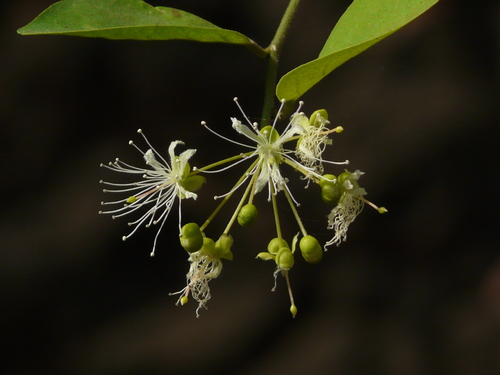
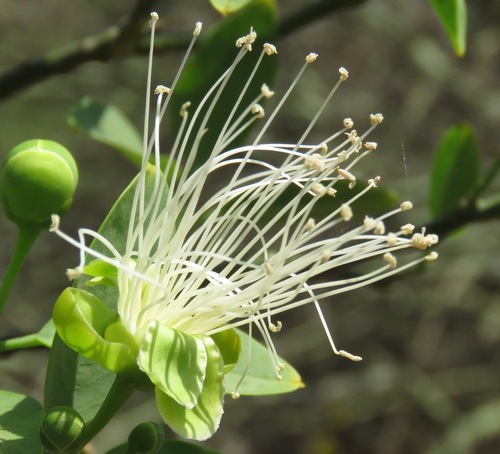
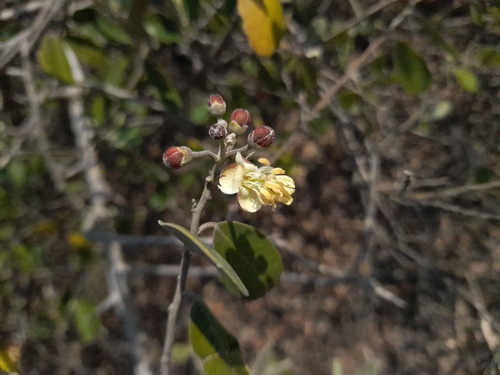
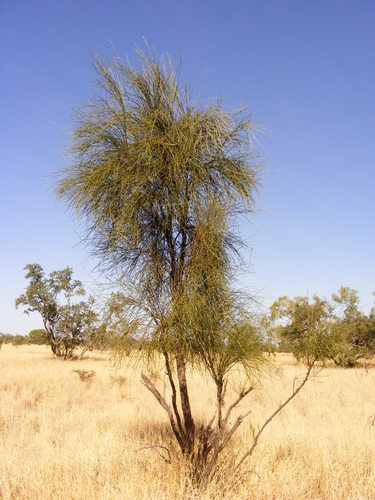
Apophyllum anomalum F.Muell., commonly called warrior bush, was renamed Capparis anomala in 2018. It was first described by government botanist Ferdinand von Mueller in 1855, several years after Mueller helped establish the National Herbarium of Victoria in 1853. Mueller introduced the species to the National Herbarium of Victoria, which today holds 19.8% of all recorded specimens of this species in Australia. According to the Australian Plant Census, the National Herbarium of New South Wales and the Herbarium of Queensland together hold 53% of the country's recordings of the warrior bush. This plant is widespread across semi-arid areas of Australia, and is predominant in New South Wales and Queensland. It is usually a small shrub growing 3 to 5 meters tall, though it may occasionally develop into a small tree; the largest recorded specimen reaches only approximately 4 meters in height. It has leafless older branches that are sometimes drooping. When leaves are present, they range from linear to lanceolate in shape and measure 5 to 15 millimeters long. Its flowers are unisexual, and can grow either singly or in clusters. Flowers have 3 to 4 hairy sepals 2 to 3 millimeters long, 2 to 5 petals 2 to 5 millimeters long, and are greenish white to yellow in colour. Male flowers have 6 to 8 stamens that are as long as the petals. Female flowers have 1 to 3 stamens, and an ovary positioned on a 2 to 3 millimeter long gymnophore. The fruits are globose, purple, and 5 to 8 millimeters in diameter. Warrior bush blooms from spring to early summer, typically flowering in November and December. Its timber is surprisingly dense with close grain and very fine medullary rays, which makes the species highly drought resistant. Young branches and berries are browsed by livestock and frequently grazed by wild goats. Macropods such as kangaroos and wallabies are commonly found in the same habitat as the warrior bush. When flowering in November and December, this plant attracts large numbers of migratory black and white caper white butterflies, and their larvae frequently cause significant damage to the plant. Because this species is effectively leafless for most of the time, the sight of clouds of butterflies surrounding this rugged shrub is quite unusual.