About Apolemichthys trimaculatus (Cuvier, 1831)
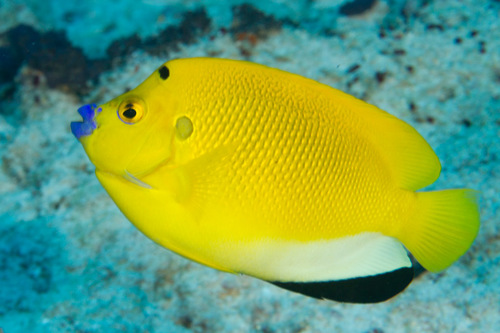
Apolemichthys trimaculatus is a bright yellow species of marine angelfish. This species has blue lips, a wide black margin on the anal fin, a black spot on the forehead, and a faint spot just behind the operculum. Juveniles do not have these spots; instead, they have a thin black band that runs vertically through the eye, plus vertical golden bars on their flanks. The dorsal fin of Apolemichthys trimaculatus has 14 spines and 16 to 18 soft rays, while the anal fin has 3 spines and 17 to 19 soft rays. This species reaches a maximum total length of 26 centimetres (10 inches).
Apolemichthys trimaculatus is widely distributed across the tropical waters of the Indian Ocean, ranging from the East African coast between Tanzania and Mozambique eastward to the western Pacific Ocean, where it extends as far east as Samoa. Its range reaches as far north as southern Japan and as far south as New Caledonia. In Australia, it occurs at Ningaloo Reef, Rowley Shoals, and Scott Reef in Western Australia; Ashmore Reef in the Timor Sea; and the Great Barrier Reef in Queensland.
This species is found at depths between 10 and 80 metres (33 to 262 feet), where it inhabits outer coral reef slopes and drop-offs. It feeds mainly on benthic invertebrates, most commonly sponges and tunicates, though it also eats crustaceans. Juveniles are more secretive and solitary than adults, and usually stay at depths greater than 25 metres (82 feet). Adults are typically found at moderate depths in small, loosely organized groups, with each male accompanied by 2 to 7 females. Males are territorial. Apolemichthys trimaculatus is diurnal and a protogynous hermaphrodite: all hatchlings are female, and individuals can change sex later in life.