About Apoica flavissima Vecht, 1972
Apoica flavissima, formally named Apoica flavissima Vecht, 1972, displays the following physical characteristics. Its mesoscutum, the middle thoracic segment, is dark yellow with prominent bristles. The gaster, the enlarged posterior section of the abdomen, the humeral plate, are both pale yellow. The posterior ocelli are widely spaced apart from the eyes. Adult individuals typically have a wing length between 15.5 and 19 millimetres, which equals 0.61 to 0.75 inches.
This species has an unusual morphological caste difference compared to most other wasp species: queens are smaller than workers in overall body size and other key measurements. Workers have longer alitrunk lengths and more hamuli than queens. Queens also differ in body coloration from workers. Queens typically have darker brown frons, clypeus, and mandible, while these regions are light yellow on workers. On workers, the basal half of the first gastral tergite is dark brown, while this area is light yellow on queens. The most distinct morphological difference between castes is found at the lateral tip of the pronotum: the queen’s tip is gradually rounded, while the worker’s tip is more acutely curved.
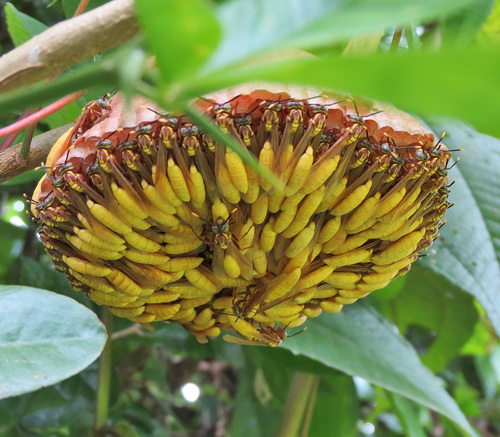
Nests of Apoica flavissima have only one comb. Young nests are typically hexagonal in shape; as they grow, they curve downward and become increasingly rounded and oval. The texture of these nests is described as felt-like.
This species is distributed across South America in the Neotropical region. It has been recorded primarily in Panama, Guyana, Suriname, French Guiana, Brazil, Paraguay, and Argentina. Nests are most often found in shaded wooded areas, which helps support the nest’s thermoregulation. Because Apoica flavissima is nocturnal, the total population size of the species is not known, though it is assumed to be relatively common.