About Apodytes dimidiata E.Mey. ex Arn.
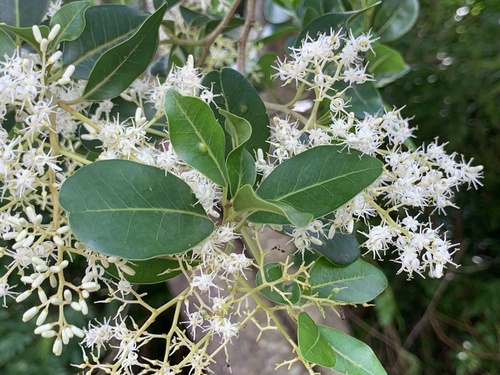
This evergreen species grows as a tall shrub or small tree around 5 m tall when grown in open conditions. In shadier habitats such as deep afro-montane forest, it can grow to over 20 m in height. It has dense, shiny bright-green foliage and smooth gray bark. It often produces abundant masses of tiny, white, sweet-scented bisexual flowers. These flowers develop into distinctively curved berries that are black and scarlet in color. In South Africa, this species is officially classified as a protected tree. It can be very difficult to identify at first, and it is frequently mistaken for Pterocelastrus rostratus — this confusion even occurred at the First International Forestry Exhibition. The most reliable identifying features of Apodytes dimidiata are its petiole and young terminal branchlets, which have a unique reddish color. Apodytes dimidiata is a prominent and common tree in South African forests. It grows naturally from Cape Town in the south, along the entire east coast of southern Africa as far north as Kenya, and extends inland to Gauteng. It typically grows in coastal thicket, afro-montane forest, and mountainous bushveld. Determining the full distribution of this species has been challenging, because over 30 different synonyms have been used for this species across different countries. Based on analysis of these synonym usages, researchers currently think the species has a much broader distribution than originally believed, and may extend as far as the Indian subcontinent. Several characteristics make Apodytes dimidiata an ideal tree for planting around paved areas, near swimming pools, next to buildings, in small gardens, and in any location that requires year-round shade: it is evergreen with attractive foliage, it produces non-fleshy fruits that do not create mess, and it has a gentle non-invasive root system that will not damage paving. White pear is most easily propagated from seed, though germination is extremely slow. Seeds take around six months to germinate, and young plants also grow relatively slowly. Once the trees become larger and more established, they grow much more quickly.

